Gaming Audio Future: 3D Spatial Sound Technologies 2026

Driven by advancements in object-based sound engines, head-tracking hardware, and AI-powered spatialization, 3D spatial sound is shifting gaming from traditional stereo setups into fully three-dimensional environments.
Gaming Audio Future examines how directional audio cues, dynamic soundtracks, and hardware integration enhance player performance and redefine competitive advantage.
The Evolution of Gaming Audio: Beyond Stereo
For decades, stereo audio has been the standard in gaming, providing a basic sense of directionality but often falling short of true immersion.
The advent of surround sound systems marked an improvement, yet still relied on discrete speaker setups that were often impractical for many gamers.
Advertisements
The current trajectory points towards sophisticated 3D spatial audio, which simulates sound sources from all directions, including above and below the player.
This technology leverages advanced algorithms to process audio, creating a perception of depth and position that closely mimics real-world hearing.
This shift is not merely an incremental upgrade; it represents a fundamental rethinking of how sound contributes to gameplay, narrative, and overall player engagement.
The goal is to make virtual environments feel more tangible and responsive to auditory cues.
From Stereo to Object-Based Audio
Traditional audio formats mix sounds into a limited number of channels, such as two for stereo or five for 5.1 surround sound.
Object-based audio, however, treats each sound source in a game as an individual ‘object’ with its own metadata, including its position, velocity, and acoustic properties within the 3D space.
This approach allows for dynamic rendering of sound, adapting in real-time to the player’s head movements and in-game position.
The result is a far more accurate and believable soundscape, where footsteps behind a wall or a distant explosion can be precisely localized.
Key technologies driving this include advanced binaural rendering for headphones and wave field synthesis for speaker arrays.
These methods are crucial for delivering a convincing 3D audio experience, regardless of the playback system.
- Object-based audio provides precise sound positioning.
- Binaural rendering optimizes headphone experiences.
- Wave field synthesis enhances multi-speaker setups.
- Dynamic soundscapes adapt to player movement.
Impact on Gameplay and Immersion
The implications of advanced 3D spatial audio for gameplay are vast.
In competitive multiplayer games, the ability to accurately pinpoint enemy positions through sound can provide a significant tactical advantage, transforming how players approach engagements.
For single-player narrative experiences, enhanced audio depth deepens immersion, making environments feel more alive and interactive.
Environmental sounds, character voices, and musical scores can all be rendered with greater realism, pulling players deeper into the game world.
This heightened realism also contributes to a stronger emotional connection with the game.
A subtle creak in a haunted mansion or the distant roar of a monster becomes more impactful when its precise origin can be discerned, amplifying tension and excitement.
Pioneering Technologies Shaping the Gaming Audio Future
Several key technologies and platforms are at the forefront of defining the Gaming Audio Future.
These innovations are not only improving sound quality but are fundamentally changing how audio is designed, implemented, and experienced in games.
Companies are investing heavily in research and development to push the boundaries of what’s possible, leading to proprietary solutions and open standards.
The competition is fierce, but the ultimate beneficiary is the gamer, who stands to gain from increasingly sophisticated auditory environments.
Understanding these specific technologies provides insight into the practical advancements making their way into consumer products and game development pipelines.
This includes both hardware and software solutions designed to deliver superior spatial audio.
Dolby Atmos and DTS:X for Gaming
Dolby Atmos and DTS:X, already established in home theater and cinema, are making significant inroads into gaming.
These object-based audio formats allow sound designers to place individual sound elements precisely in a 3D space, rather than simply assigning them to channels.
This means that a helicopter flying overhead will sound like it’s truly above you, and a whisper from a character will seem to originate from their exact in-game location.
Both technologies leverage metadata to dynamically render sound, adapting to various playback systems, from headphones to full home theater setups.
Their integration into gaming consoles and PC platforms is accelerating, with an increasing number of titles supporting these advanced formats. This widespread adoption is a strong indicator of the direction the Gaming Audio Future is heading.
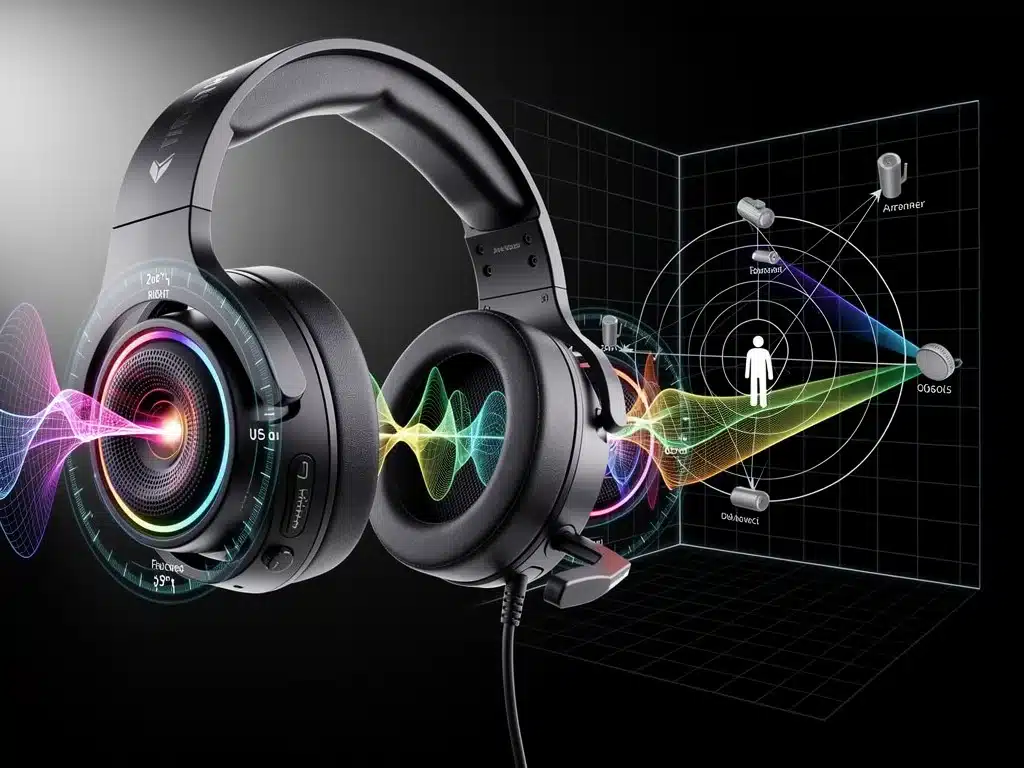
Sony’s Tempest 3D AudioTech
Sony’s PlayStation 5 introduced Tempest 3D AudioTech, a dedicated audio engine designed to deliver highly immersive spatial audio.
This proprietary hardware and software solution is capable of processing hundreds of sound sources simultaneously, each with its own unique acoustic properties.
Tempest 3D AudioTech aims to provide a personalized audio experience for every player, regardless of their headphone type.
Sony has emphasized its ambition to make 3D audio as ubiquitous and impactful as graphical advancements, positioning it as a core feature of the PS5 experience.
The technology uses Head-Related Transfer Functions (HRTFs) to simulate how sound interacts with an individual’s head and ears, creating a highly convincing sense of direction and distance.
This focus on personalized audio is a critical element in the evolving Gaming Audio Future.
- Tempest 3D AudioTech is a dedicated PS5 audio engine.
- It processes hundreds of simultaneous sound sources.
- HRTFs personalize the audio experience.
- Sony aims for ubiquitous 3D audio adoption.
The Role of AI and Machine Learning in Spatial Audio
Artificial intelligence and machine learning are increasingly playing a crucial role in enhancing spatial audio technologies.
These advanced computational methods are enabling more realistic, dynamic, and personalized audio experiences than ever before.
AI can be leveraged for various tasks, from optimizing binaural rendering to generating realistic environmental acoustics in real-time.
This integration promises to make the Gaming Audio Future even more adaptive and intelligent, responding to player actions and environmental changes with unprecedented fidelity.
The continuous learning capabilities of machine learning algorithms can refine audio models over time, leading to more accurate sound localization and a deeper sense of presence.
This represents a significant leap from static, pre-rendered audio assets.
AI-Powered HRTF Personalization
One of the challenges in delivering truly convincing 3D audio is the individual variation in Head-Related Transfer Functions (HRTFs).
These functions describe how our ears perceive sound from different directions, and they are unique to each person due to differences in ear shape, head size, and other physiological factors.
AI and machine learning are being used to personalize HRTFs, either by rapidly generating custom HRTFs from simple measurements or by adapting generic HRTFs to better match an individual’s perception.
This customization significantly enhances the realism and immersion of spatial audio.
Companies are developing tools that can create a personalized HRTF profile for a user through a quick scan or even a series of audio tests.
This level of personalization is a game-changer for the Gaming Audio Future, ensuring that spatial cues are perceived as intended by the game developers.
Dynamic Environmental Acoustics
AI can also be employed to dynamically generate and adapt environmental acoustics in real-time.
Instead of relying on pre-baked reverb and echo effects, machine learning models can analyze the geometry of a virtual space and simulate how sound would naturally propagate within it.
This means that sounds will realistically bounce off surfaces, be absorbed by materials, and be occluded by obstacles, all in real-time.
The result is an incredibly authentic and responsive soundscape that changes dynamically as the player moves through different environments.
Such dynamic acoustics contribute immensely to the believability of a game world, making every location feel distinct and acoustically accurate.
This level of detail is a cornerstone of the immersive experiences promised by the Gaming Audio Future.
Hardware Innovations and the Gaming Audio Future
While software and algorithms are crucial, hardware innovations are equally important in delivering the full potential of 3D spatial audio.
Specialized headphones, sound cards, and even haptic feedback devices are evolving to support these advanced audio experiences.
The synergy between hardware and software is essential for optimal performance, ensuring that the intricate details of spatial audio are accurately reproduced for the player.
Manufacturers are collaborating closely with game developers to create integrated solutions.
These hardware advancements are not just about louder or clearer sound; they are about precise reproduction of spatial cues, comfort for extended gaming sessions, and seamless integration with existing gaming setups.
The Gaming Audio Future demands more from peripherals.
Advanced Gaming Headsets
Gaming headsets are at the forefront of hardware innovation for spatial audio.
Manufacturers are integrating dedicated processors and advanced drivers capable of reproducing the subtle nuances of 3D soundscapes. Many premium headsets now come with built-in support for Dolby Atmos or DTS Headphone:X.
Beyond just sound reproduction, features like active noise cancellation are becoming more prevalent, ensuring that external distractions do not break immersion.
Comfort and ergonomics are also continuously refined, as gamers often wear headsets for hours on end.
Wireless technologies are also improving, offering low-latency connections that are crucial for competitive gaming where every millisecond counts.
The evolution of gaming headsets is central to the accessibility and quality of the Gaming Audio Future for many players.
Haptic Feedback Integration
While not strictly audio, haptic feedback is increasingly being integrated with spatial audio to enhance immersion.
Controllers with advanced haptic motors can translate in-game sounds into tactile sensations, adding another layer to the sensory experience.
For example, a low rumble associated with a distant explosion can be felt in the hands, or the distinct vibration of a specific weapon firing can be mimicked.
This multi-sensory approach deepens the player’s connection to the game world, making it feel more tangible.
The integration of haptics with spatial audio creates a more holistic immersive experience, where what you hear is reinforced by what you feel.
This synergistic development points to a richer, more engaging Gaming Audio Future.
Challenges and Opportunities in 3D Spatial Audio Adoption
Despite the undeniable potential, the widespread adoption of 3D spatial audio in gaming faces several challenges.
These include technical hurdles, content creation complexities, and the need for greater consumer awareness and education.
Overcoming these challenges will be crucial for realizing the full promise of the Gaming Audio Future. However, each challenge also presents an opportunity for innovation and market leadership for companies willing to invest in solutions.
The industry is actively working on standardizing technologies and simplifying development tools to accelerate adoption. The goal is to make advanced spatial audio a default expectation rather than a niche feature.
Content Creation Complexity
Designing games with true 3D spatial audio is significantly more complex than traditional audio design.
Game developers need specialized tools and expertise to accurately place and mix hundreds of individual sound objects within a dynamic environment.
This requires a shift in workflow and a greater emphasis on audio engineering throughout the development cycle. Training audio designers in these new methodologies is essential to ensure high-quality spatial sound experiences.
The investment in time and resources for spatial audio content creation is substantial, but the payoff in terms of immersion and player experience is equally significant.
Simplifying these tools and processes is a key area of focus for the Gaming Audio Future.
- Spatial audio design is more complex than traditional audio.
- Specialized tools and expertise are required.
- Workflows need to adapt for object-based audio.
- Investment in audio engineering is crucial.
Consumer Awareness and Accessibility
For 3D spatial audio to truly flourish, consumers need to understand its benefits and have access to compatible hardware.
Many gamers may not yet realize the transformative impact that high-quality spatial audio can have on their gaming experience.
Marketing and educational efforts are necessary to highlight the advantages of spatial audio over conventional stereo. Making the technology accessible across a range of price points and platforms is also vital for broader adoption.
As more games integrate these features and hardware becomes more affordable, the barrier to entry will decrease. This improved accessibility will be a major driver for the growth of the Gaming Audio Future.
Key Players and Market Trends for 2026
The competitive landscape for 3D spatial audio in gaming is dynamic, with established tech giants and innovative startups vying for market share.
Understanding the strategies of these key players and the overarching market trends provides insight into what to expect by 2026.
Consolidation, partnerships, and continued investment in R&D are defining this space.
The race is on to develop the most compelling and widely adopted spatial audio solutions, which will ultimately shape the auditory experiences of millions of gamers.
Analysts anticipate significant growth in the market for spatial audio hardware and software, driven by increasing consumer demand for immersive entertainment.
This growth will further accelerate the pace of innovation in the Gaming Audio Future.
Major Console Manufacturers and PC Platforms
Sony with its Tempest 3D AudioTech and Microsoft with its support for Dolby Atmos and DTS:X on Xbox are leading the charge in the console space.
Both companies recognize the strategic importance of superior audio for next-generation gaming.
On the PC front, companies like NVIDIA and AMD are integrating spatial audio processing capabilities into their GPUs, while dedicated sound card manufacturers continue to innovate.
Software platforms like Windows Sonic and third-party solutions also play a significant role.
The competition between these platforms is driving rapid advancements, ensuring that a wide array of options will be available to gamers by 2026.
This multi-platform approach is crucial for the widespread adoption of the Gaming Audio Future.
Audio Middleware and SDKs
Audio middleware providers such as Wwise (Audiokinetic) and FMOD are instrumental in bringing advanced spatial audio capabilities to game developers.
These tools provide comprehensive frameworks for designing, implementing, and mixing complex soundscapes.
The continuous evolution of these SDKs (Software Development Kits) includes better integration with game engines like Unreal Engine and Unity, as well as support for the latest spatial audio formats.
This simplifies the development process for studios, making spatial audio more accessible.
As these tools become more powerful and user-friendly, even smaller development teams can create highly immersive audio experiences.
This democratization of spatial audio development is a positive trend for the overall Gaming Audio Future.
The Promise of Hyper-Realistic Sound Environments
The ultimate goal of 3D spatial audio is to create hyper-realistic sound environments that are indistinguishable from real-world acoustics.
This level of fidelity promises to blur the lines between virtual and physical spaces, enhancing immersion to unprecedented levels.
Imagine hearing the distinct echo of your footsteps in a cavern, the precise direction of a rustling bush, or the subtle changes in a character’s voice as they move through different rooms.
These details contribute to a feeling of true presence within the game world.
Achieving this hyper-realism requires continuous innovation across hardware, software, and content creation. The journey towards this goal is what defines the exciting trajectory of the Gaming Audio Future.
Future Trends: Personalized and Adaptive Audio
Looking beyond 2026, the trend towards personalized and adaptive audio will only accelerate.
Future systems may dynamically adjust audio parameters based on player biometrics, emotional state, or even cognitive load, creating a truly bespoke auditory experience.
Imagine a game that subtly alters its soundscape to increase tension when it detects your heart rate rising, or one that adapts dialogue volume based on your current focus.
This level of intelligent audio will mark a new frontier in immersive gaming.
The integration of AI, machine learning, and biometric data will be key to unlocking these advanced capabilities, further blurring the lines between player and game.
This highly personalized approach represents the pinnacle of the Gaming Audio Future.
Economic Impact and Market Growth
The growth of 3D spatial audio technologies is not just about technological advancement; it also represents a significant economic opportunity.
The market for gaming audio hardware and software is projected to expand considerably in the coming years.
This growth is driven by increasing consumer demand for premium gaming experiences, the rise of esports, and the continuous innovation from manufacturers.
Investment in this sector is attracting new talent and fostering a competitive environment.
The ripple effect extends to content creators, developers, and peripheral manufacturers, all benefiting from the heightened focus on audio fidelity. This robust economic landscape underscores the importance of the Gaming Audio Future.
| Key Aspect | Description |
|---|---|
| Object-Based Audio | Individual sound sources positioned dynamically in 3D space. |
| AI Personalization | AI-driven HRTF customization for unique auditory profiles. |
| Hardware Evolution | Advanced headsets and haptics enhancing spatial audio delivery. |
| Market Growth | Significant expansion projected for spatial audio hardware and software. |
Frequently Asked Questions About Gaming Audio Future
3D spatial sound in gaming creates the illusion of sound originating from specific points in a 3D environment, including above and below the player. It uses advanced algorithms to process audio, making virtual soundscapes feel more realistic and immersive than traditional stereo or surround sound.
In competitive gaming, 3D spatial audio provides a significant tactical advantage. Players can more accurately pinpoint enemy locations, track movement, and react to auditory cues, leading to improved situational awareness and better performance in fast-paced scenarios, fundamentally changing engagement strategies.
AI and machine learning are crucial for personalizing HRTFs and dynamically generating environmental acoustics. AI can optimize sound rendering for individual players and simulate realistic sound propagation in real-time, creating highly adaptive and believable soundscapes that enhance immersion significantly.
Key players include Sony with its Tempest 3D AudioTech for PlayStation 5, Microsoft supporting Dolby Atmos and DTS:X on Xbox, and audio middleware providers like Audiokinetic (Wwise) and FMOD. These companies are driving innovation across both hardware and software solutions.
While some basic spatial audio can be experienced with standard headphones, advanced experiences benefit from dedicated gaming headsets with integrated processors, specialized sound cards, and compatible consoles or PCs. Future systems may also integrate advanced haptic feedback for a multi-sensory approach.
Looking Ahead: The Immersive Horizon
The trajectory for the Gaming Audio Future indicates a rapid evolution towards hyper-realistic and personalized sound experiences.
The advancements in 3D spatial sound technologies are not just about better audio; they are about fundamentally enhancing player immersion and interaction.
To learn more about market trends, emerging regions, and industry insights driving this sector, check out this executive overview on gaming audio growth in emerging markets.
As hardware and software continue to converge, and AI plays an increasingly vital role, the line between virtual and physical auditory sensations will blur further.
This ongoing transformation promises a richer, more engaging gaming landscape for 2026 and beyond, making every sound a critical component of the adventure.
Monitoring the continued integration of these technologies into major titles and platforms will be essential.
The competitive drive among developers and manufacturers ensures that the pace of innovation in the Gaming Audio Future will remain high, delivering unprecedented auditory depth to gamers worldwide.