Cooling Solutions 2026: Air vs. Liquid – Data-Backed Performance
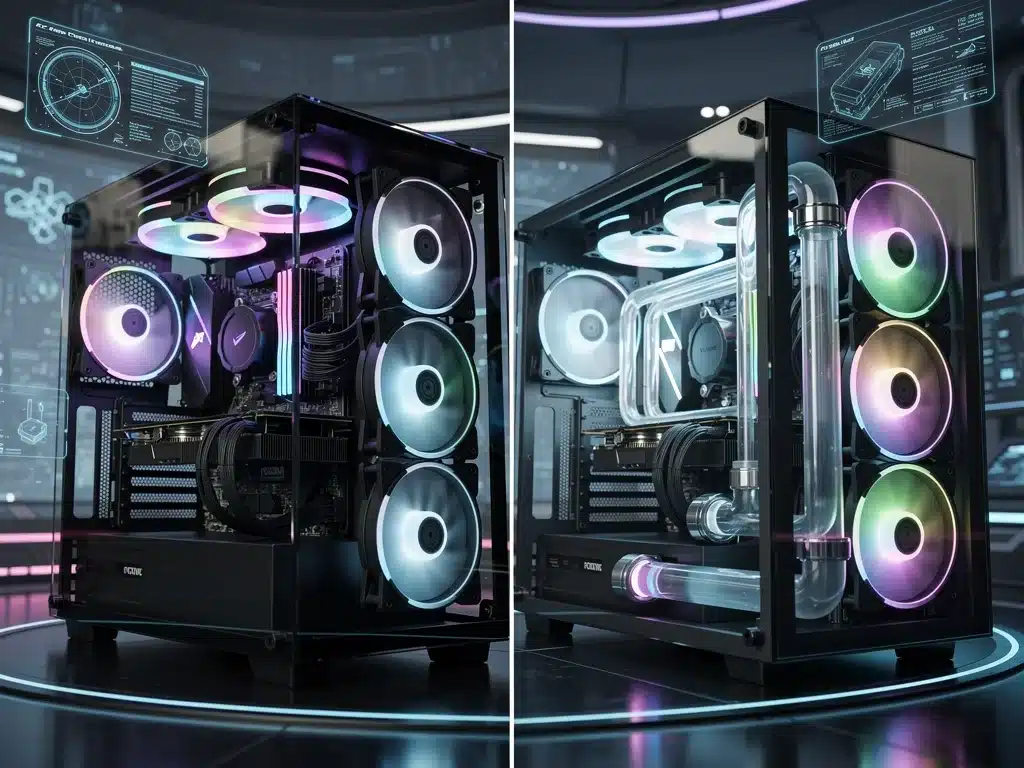
As modern high-performance processors demand greater thermal dissipation, choosing the right PC thermal management strategy is essential.
Cooling Solutions for 2026 analyzes benchmarks, long-term acoustic profiles, and cost-to-performance ratios to help enthusiasts optimize system stability under heavy workloads.
The Evolving Landscape of PC Thermal Management
The demands placed on PC cooling systems continue to escalate with each new generation of processors and graphics cards.
Advertisements
High clock speeds and increased core counts translate directly into higher thermal design power (TDP), making efficient heat dissipation paramount.
Manufacturers are innovating rapidly, introducing advanced materials, improved fan designs, and more sophisticated pump technologies.
These advancements aim to keep pace with the thermal output of cutting-edge hardware, ensuring stability and preventing thermal throttling.
Understanding these developments is crucial for anyone building or upgrading a gaming PC in 2026. The choice of cooling solution directly impacts not only performance but also system noise, aesthetics, and overall budget.
Air Cooling: A Refined Classic for 2026
Air cooling, often seen as the traditional approach, has undergone significant innovation to remain competitive in the high-performance segment. Modern air coolers feature meticulously engineered heatsinks, complex fin arrays, and high-performance fans.
These designs maximize surface area for heat dissipation and optimize airflow dynamics. The goal is to efficiently transfer heat from the CPU to the ambient air within the PC case, relying on case fans to exhaust that warmed air.
The simplicity and reliability of air cooling continue to appeal to a broad user base. Its effectiveness for a wide range of CPUs, coupled with a generally lower entry cost, positions it as a strong contender in Cooling Solutions.
Key Advancements in Air Cooling Technology
Recent breakthroughs include the integration of vapor chambers directly into heatsink bases, significantly improving heat transfer away from the CPU IHS.
Additionally, fan technology has seen improvements in static pressure and noise-to-performance ratios.
These advancements allow premium air coolers to compete effectively with entry-level and even some mid-range liquid coolers.
The robust nature of air coolers, lacking pumps and liquid, also contributes to their perceived longevity and reduced maintenance.
- Improved Heat Pipe Designs: Larger diameter pipes and more efficient wicking structures.
- Enhanced Fan Blades: Optimized for higher static pressure and lower acoustic output.
- Advanced Heatsink Coatings: Materials that promote better thermal conductivity and heat radiation.
Performance Metrics for Air Cooling in 2026
Data from independent reviews and manufacturer benchmarks indicates that top-tier air coolers can manage CPUs with TDPs exceeding 250W under sustained loads.
This performance level is crucial for demanding applications and competitive gaming.
For instance, tests show that flagship air coolers maintain CPU temperatures in the low 70s Celsius during prolonged stress tests on Intel i9 and AMD Ryzen 9 processors.
This performance is often achieved with acceptable noise levels, especially when fans are properly configured.
However, air cooling performance is inherently tied to ambient room temperature and case airflow. A well-ventilated case is essential to maximize the efficiency of any air cooling setup, as it relies on a constant supply of cooler air.
Liquid Cooling: The Performance and Aesthetic Edge
Liquid cooling, particularly All-in-One (AIO) solutions, has become increasingly popular due to its superior thermal performance and sleek aesthetics.
AIOs offer a self-contained loop that is easier to install than custom liquid cooling setups.
These systems utilize a pump to circulate coolant through a cold plate that sits on the CPU, absorbing heat.
The heated coolant then travels to a radiator, where fans dissipate the heat into the ambient air, much like a car’s radiator.
The ability of liquid to transfer heat more efficiently than air allows liquid coolers to often achieve lower CPU temperatures, especially under heavy, sustained workloads.
This makes them a prime consideration for Cooling Solutions.
Innovations in Liquid Cooling Systems
The 2026 market sees AIOs with larger radiators (up to 420mm), more powerful and quieter pumps, and enhanced cold plate designs.
These improvements translate to even better thermal dissipation and reduced acoustic profiles.
Many modern AIOs also incorporate integrated displays on the CPU block, allowing users to monitor temperatures, display custom images, or even show system statistics.
This blending of functionality and aesthetics is a significant draw for enthusiasts.
- Improved Pump Technology: Quieter operation and increased flow rates for better heat transfer.
- Larger Radiator Options: More surface area for heat exchange, supporting higher TDPs.
- Advanced Coolant Formulations: Designed for optimal thermal conductivity and corrosion resistance.
Liquid Cooling Performance and Considerations for 2026
Benchmark data consistently shows that high-end AIO liquid coolers outperform even the best air coolers in terms of raw thermal performance. They often achieve CPU temperatures several degrees lower, providing more headroom for overclocking.
For example, tests on extreme processors often show AIOs keeping temperatures in the mid-60s Celsius under full load, a notable advantage for users pushing their systems to the limit.
This thermal efficiency is a key factor in the discussion around Cooling Solutions.
However, liquid cooling introduces additional points of failure, such as the pump or potential leaks, though modern AIOs are highly reliable. The installation can also be more complex, and they generally come at a higher price point than air coolers.
Cost Analysis: Air vs. Liquid Cooling in 2026
The financial aspect plays a significant role in determining the ideal cooling solution for many users.
Air coolers typically offer a more budget-friendly entry point, with effective models available across various price segments.
High-performance air coolers can range from $50 to $100, providing excellent value for their thermal capabilities.
This affordability makes them a popular choice for gamers and builders who prioritize performance without breaking the bank.
Liquid cooling, particularly AIOs, generally demands a higher investment.
Entry-level AIOs start around $80-$100, while premium models with larger radiators and advanced features can easily exceed $200-$250, reflecting their complex components and enhanced capabilities in Cooling Solutions.
Long-Term Value and Maintenance
When considering long-term value, air coolers often come out ahead due to their simpler mechanics and fewer moving parts. They typically require minimal maintenance, primarily consisting of periodic dust removal from fins and fans.
Liquid coolers, while robust, have a finite lifespan for their pumps and coolant. While sealed AIOs require no coolant refills, their pumps are mechanical components that can eventually fail, usually after several years.
This aspect is important for a data-backed comparison of Cooling Solutions.
The potential for higher long-term costs due to eventual replacement or, in rare cases, warranty claims related to leaks, should be factored into the overall cost of ownership for liquid cooling solutions.
Noise Levels and Acoustics: A Critical Factor
For many PC users, especially those sensitive to noise, the acoustic performance of a cooling solution is as important as its thermal capabilities. Both air and liquid coolers generate noise, primarily from their fans and, in the case of liquid coolers, the pump.
Modern fans on both types of coolers have seen significant improvements, utilizing fluid dynamic bearings and optimized blade designs to reduce noise while maintaining airflow.
However, higher performance often correlates with increased noise output.
Data indicates that a well-tuned air cooler can be remarkably quiet at idle and under moderate loads.
At full load, the noise levels are comparable to those of an AIO liquid cooler, often within a few decibels of each other, making this a key point in Cooling Solutions.
Managing Noise in High-Performance Setups
Liquid coolers introduce pump noise, which can be a low hum or whine, depending on the pump’s quality and speed. While often minimal, some users are more sensitive to this distinct sound profile compared to fan noise.
Many cooling solutions now offer software control over fan and pump speeds, allowing users to create custom fan curves.
This enables a balance between thermal performance and acoustic comfort, tailoring the cooling to specific usage scenarios.
Choosing a cooler with larger fans (e.g., 140mm instead of 120mm) or a larger radiator (for liquid coolers) can also contribute to lower noise levels, as these can achieve similar cooling performance at lower RPMs.
Installation and Compatibility for 2026 Systems
Ease of installation and system compatibility are practical considerations for any PC builder.
Air coolers, especially larger tower models, can sometimes be challenging to install due due to their size and weight, potentially interfering with RAM clearance or case panels.
However, their mounting mechanisms have become standardized and generally straightforward. Compatibility with various CPU sockets is typically broad, with manufacturers providing brackets for current and recent platforms.
Liquid coolers, particularly AIOs, can be simpler to mount onto the CPU socket, but require careful planning for radiator placement within the case.
Radiator size (e.g., 240mm, 360mm) dictates available mounting points, which must be checked against case specifications. This is a crucial aspect of Cooling Solutions.
Potential Installation Hurdles
Large air coolers can sometimes block access to RAM slots, especially on smaller motherboards, requiring careful selection of low-profile RAM. Similarly, their sheer size can make working inside the case more difficult.
AIO liquid coolers, while offering more clearance around the CPU socket, demand adequate space for their radiators. This might mean sacrificing a top fan mount or front panel space, impacting overall case airflow if not planned correctly.
Always verify the dimensions of the chosen cooler against your case and motherboard specifications to avoid compatibility issues. This pre-planning is essential for a smooth build process and optimal cooling performance.
Aesthetics and System Integration
Beyond raw performance, the visual appeal and how a cooling solution integrates into the overall build aesthetic are significant factors for many enthusiasts.
Both air and liquid coolers offer distinct visual styles that can dramatically alter the look of a gaming PC.
Air coolers, especially high-end models, can present a powerful, industrial aesthetic with their large heatsinks and exposed heat pipes. Some manufacturers offer various color schemes or integrated RGB lighting to enhance their appearance.
Liquid coolers, particularly AIOs, are often chosen for their clean, minimalist look around the CPU socket and the visual flair of their radiators and RGB-enabled fans.
The illuminated tubing and CPU blocks add a modern, high-tech vibe to any build, contributing to the discussion on Cooling Solutions.
Customization and Visual Impact
Custom liquid cooling loops offer the ultimate in aesthetic customization, allowing users to select specific colors for coolant, tubing, and fittings. This level of personalization can transform a PC into a unique work of art.
However, custom loops are significantly more complex and expensive than AIOs or air coolers, requiring advanced knowledge for installation and maintenance. For the average user, AIOs provide a good balance of performance, aesthetics, and ease of use.
Ultimately, the choice often comes down to personal preference and the desired visual theme for the PC build. Both air and liquid cooling have evolved to offer compelling aesthetic options for modern gaming systems.
Reliability and Longevity: A Long-Term Perspective
The long-term reliability of a cooling solution is a critical consideration, especially for components designed to protect expensive hardware.
Air coolers are generally considered to be highly reliable due to their relatively simple design.
With no moving parts other than fans, the primary failure points are limited to the fans themselves, which are easily replaceable.
This inherent simplicity contributes to their robust nature and extended lifespan, making them a strong contender in Cooling Solutions.
Liquid coolers, while increasingly reliable, have more potential points of failure, including the pump, tubing, and seals. While leaks are rare in modern AIOs, the possibility, however remote, is a concern for some users.
Understanding Failure Rates and Warranties
Data from manufacturers and long-term user reports indicate that pump failures in AIOs typically occur after 3-5 years, although many units last much longer.
Reputable brands often offer extensive warranties (3-6 years) to cover potential issues.
Air coolers often come with similar or even longer warranties, reflecting their simpler design. The lifespan of fans on both types of coolers is generally comparable, with high-quality fans lasting many years under normal operating conditions.
When making a choice, consider the warranty period and the manufacturer’s reputation for customer support. This provides an additional layer of assurance for the longevity and reliability of your chosen cooling solution.
| Key Aspect | Data-Backed Comparison |
|---|---|
| Thermal Performance | Liquid cooling generally offers lower peak temperatures, especially for high-TDP CPUs. Air cooling excels for mid-range to high-end CPUs. |
| Cost Efficiency | Air coolers provide superior performance-to-price ratio. Liquid cooling involves higher initial investment. |
| Reliability & Longevity | Air cooling boasts simpler mechanics and fewer failure points. Liquid cooling has robust designs but includes pump lifespan considerations. |
| Noise Levels | Both can be quiet with quality components and proper tuning. Liquid coolers introduce potential pump hum. |
Frequently Asked Questions About 2026 Cooling Solutions
For extreme overclocking, liquid cooling, especially larger AIOs (360mm+) or custom loops, generally provides superior thermal headroom. The efficient heat transfer of liquid allows for lower temperatures under very heavy loads, crucial for pushing CPU frequencies beyond stock limits, according to recent benchmarks.
Absolutely. High-end air coolers in 2026 are highly effective, capable of managing even the most powerful CPUs under gaming loads without throttling. Their reliability, lower cost, and ease of maintenance make them a compelling choice for many gamers seeking robust Cooling Solutions for 2026.
AIO liquid coolers require minimal maintenance, primarily dust removal from the radiator fins. Custom loops, however, need periodic coolant flushing and replacement (typically every 1-2 years) to prevent buildup and ensure optimal performance. Always refer to the manufacturer’s guidelines for specific models.
Yes, case airflow is critical for both air and liquid cooling. For air coolers, good airflow ensures a constant supply of cool air to the heatsink. For liquid coolers, it helps exhaust the heat dissipated by the radiator. Proper fan configuration and case design are vital for overall system thermal management.
Consider your CPU’s TDP, budget, aesthetic preferences, and tolerance for noise. If you prioritize maximum overclocking and aesthetics, liquid cooling might be better. If reliability, cost-effectiveness, and simpler maintenance are key, high-end air cooling is an excellent choice for Cooling Solutions for 2026.
Perspectives for Gaming Tech in 2026
The data-backed comparison of Cooling Solutions for 2026: Air vs. Liquid – A Data-Backed Comparison for Sustained Performance reveals that both air and liquid cooling have distinct advantages and continue to evolve.
As CPU and GPU power densities increase, thermal management will remain a paramount concern for gaming enthusiasts and professionals alike.
Beyond high-performance computing, sustainable thermal control strategies are driving broader technological and environmental standards—you can learn more about international initiatives for energy-efficient climate control through the Climate & Clean Air Coalition’s cooling solutions hub.
The choice between these two primary cooling methods is becoming increasingly nuanced, moving beyond simple performance metrics to encompass factors like noise, aesthetics, and long-term reliability.
Gamers should evaluate their specific needs and budget carefully, considering the detailed insights provided by current industry analysis and independent testing.
Ultimately, the best cooling solution is one that effectively manages temperatures for your specific hardware, fits within your budget, and aligns with your personal preferences for system aesthetics and maintenance.
The ongoing innovation in both air and liquid cooling ensures that users will have robust options for sustained performance in 2026 and beyond.