Motherboard Selection 2026: Key Features for Intel Core Ultra and AMD Ryzen 8000 Series Processors
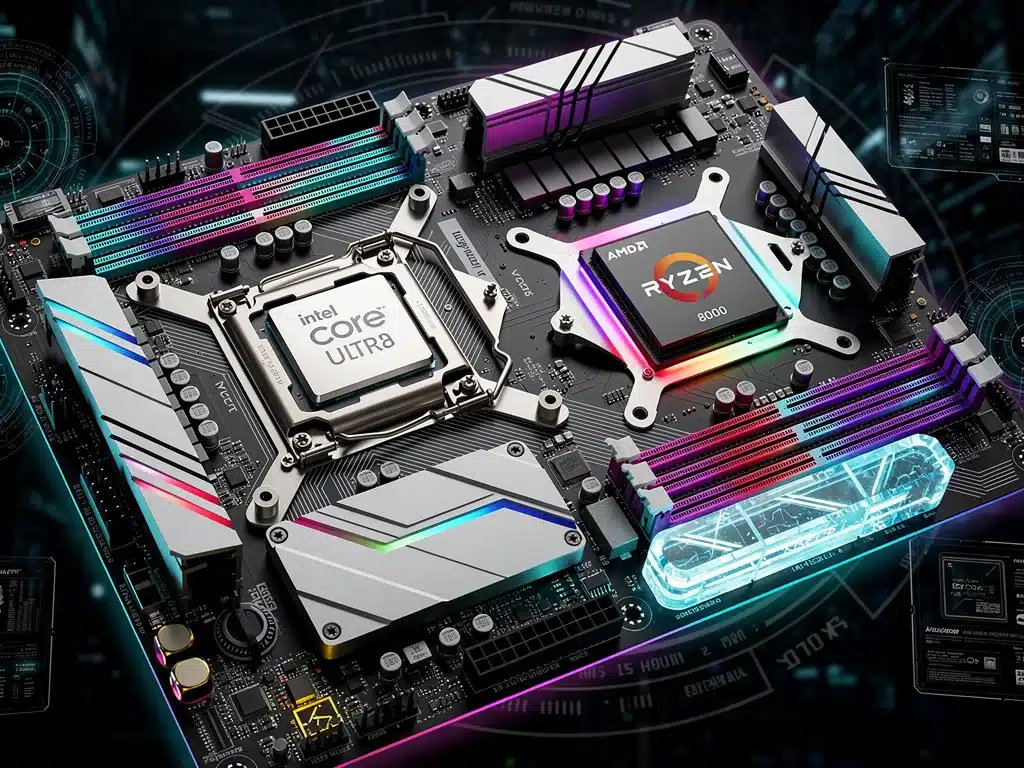
Choosing the right platform is critical as next-generation CPU architectures demand higher power delivery, faster connectivity, and expanded bandwidth.
Motherboard Selection 2026: Key Features for Intel Core Ultra and AMD Ryzen 8000 Series Processors highlights the essential chipsets, expansion capabilities, and future-proofing features needed to build a high-performance system.
The Evolving Landscape of CPU Sockets and Chipsets
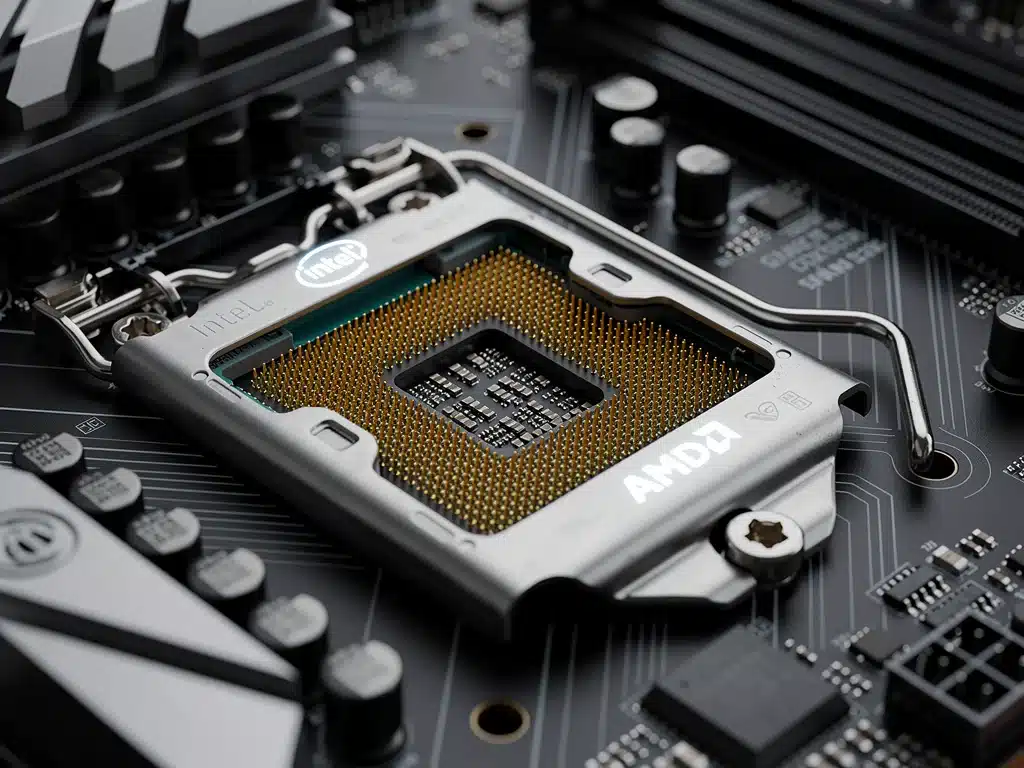
The transition to new CPU architectures, specifically Intel Core Ultra and AMD Ryzen 8000 Series Processors, brings with it updated socket designs and corresponding chipsets.
These changes are fundamental, dictating which motherboards are compatible with the latest processors and their unique features.
Advertisements
For Intel, the move towards a new socket, likely LGA 1851, is anticipated to support the Core Ultra line, focusing on enhanced AI capabilities and integrated graphics.
AMD’s AM5 socket, introduced with Ryzen 7000, is expected to maintain compatibility through the Ryzen 8000 series, offering a stable platform for several generations.
This socket evolution is not merely physical; it signifies a complete overhaul of the underlying infrastructure, including PCIe generations, memory standards, and power delivery mechanisms.
Making an informed Motherboard Selection 2026 requires a deep dive into these foundational elements.
Next-Gen CPU Socket Compatibility
The primary concern for any builder is ensuring the chosen motherboard physically supports the desired processor. Intel’s new socket will require dedicated motherboards, while AMD’s continued use of AM5 offers a degree of forward compatibility.
This compatibility extends beyond physical fit to electrical specifications and BIOS support. Early adopters of new platforms will need to pay close attention to manufacturer updates and validated processor lists.
Choosing the correct socket is the first and most crucial step in Motherboard Selection 2026, as it forms the bedrock of your entire system.
Advanced Chipset Features
Chipsets are the communication hubs of a motherboard, enabling data flow between the CPU, memory, storage, and peripherals. For 2026, chipsets will be designed to unlock the full potential of Intel Core Ultra and AMD Ryzen 8000 Series Processors.
Expect enhanced PCIe Gen 5 and potentially Gen 6 support, more USB4 and Thunderbolt 5 ports, and improved connectivity for NVMe storage devices. These advancements are vital for high-performance gaming and content creation.
The chipset selection significantly influences the feature set and capabilities of your chosen motherboard, making it a key factor in Motherboard Selection 2026.
Power Delivery Systems and VRM Design
Modern CPUs, especially high-performance gaming processors like Intel Core Ultra and AMD Ryzen 8000 Series Processors, demand robust and stable power delivery.
The Voltage Regulator Module (VRM) on a motherboard is responsible for this critical task, converting and supplying power to the CPU.
For Motherboard Selection 2026, a strong VRM design with sufficient power phases and high-quality components is non-negotiable.
This ensures stable performance, especially during sustained loads and overclocking, preventing thermal throttling and maximizing CPU potential.
Inadequate power delivery can severely limit the performance of even the most powerful processors, making VRM quality a primary consideration. Overlooking this aspect can lead to instability and suboptimal system performance.
VRM Phase Count and Component Quality
The number of power phases in a VRM system directly correlates with its ability to deliver stable power and dissipate heat effectively. More phases generally mean better power distribution and lower operating temperatures for the VRM components.
Beyond phase count, the quality of MOSFETs, chokes, and capacitors used in the VRM is crucial.
Reputable motherboard manufacturers utilize premium components designed for durability and efficiency, a key differentiator in Motherboard Selection 2026.
Investing in a motherboard with a well-engineered VRM safeguards your CPU’s performance and longevity, contributing significantly to a stable gaming experience.
Cooling Solutions for VRMs
High-performance VRMs generate considerable heat, especially under heavy loads. Effective cooling is essential to prevent thermal throttling of the power delivery system, which can impact CPU performance.
Motherboards designed for Intel Core Ultra and AMD Ryzen 8000 Series Processors will feature robust VRM heatsinks, often with elaborate fin arrays and heat pipes.
Some premium models might even incorporate active cooling solutions for critical components.
When considering Motherboard Selection 2026, evaluate the VRM cooling design carefully. A well-cooled VRM ensures consistent power delivery and contributes to the overall stability of your system.
Memory Support: DDR5 and Beyond
As we move towards 2026, DDR5 memory is firmly established as the standard, with higher speeds and improved efficiency compared to DDR4.
Motherboard Selection 2026 will focus on optimizing DDR5 performance and potentially preparing for future memory technologies.
Both Intel Core Ultra and AMD Ryzen 8000 Series Processors will leverage DDR5 to its fullest, demanding motherboards that support high-frequency memory kits and offer robust memory overclocking capabilities.
The memory controller’s integration within the CPU means motherboard design must complement these advancements.
The impact of memory speed and latency on gaming performance is significant, making robust DDR5 support a critical feature. Future-proofing your build involves selecting a motherboard that can handle increasingly faster RAM modules.
DDR5 Frequency and Overclocking
DDR5 memory modules are continually pushing the boundaries of frequency, with speeds exceeding 8000 MT/s becoming more common. Motherboards must provide stable power and signal integrity to support these extreme speeds.
Advanced BIOS options for memory overclocking, including extensive timing adjustments and voltage controls, will be a hallmark of premium motherboards. This allows users to fine-tune their memory for maximum performance.
For optimal gaming performance, consider a motherboard that explicitly supports high-frequency DDR5 and offers excellent memory overclocking potential as part of your Motherboard Selection 2026.
Memory Capacity and Slots
While gaming typically doesn’t require extreme amounts of RAM, having sufficient capacity and expansion options is important for multitasking and future applications.
Most gaming motherboards feature four DIMM slots, allowing for up to 128GB or even 256GB of DDR5 memory.
Consider your current and future memory needs when making your Motherboard Selection 2026. While 32GB or 64GB might be sufficient for most gamers today, having the option to expand later provides valuable flexibility.
The physical layout of memory slots and their proximity to the CPU socket can also influence cooling and signal integrity, subtle but important details for peak performance.
Storage and Connectivity Enhancements
The demand for faster storage and versatile connectivity options continues to grow.
Motherboard Selection 2026 will emphasize extensive NVMe PCIe Gen 5 support, advanced USB standards, and next-generation networking capabilities to meet these needs.
Intel Core Ultra and AMD Ryzen 8000 Series Processors will benefit immensely from these advancements, enabling lightning-fast game loading times, rapid data transfers, and seamless peripheral integration.
The motherboard acts as the central hub for all these connections.
Ensuring your chosen motherboard offers a comprehensive suite of storage and connectivity options is crucial for a modern, high-performance gaming PC. This directly impacts the user experience and system responsiveness.
PCIe Gen 5 NVMe Support
PCIe Gen 5 NVMe SSDs offer double the bandwidth of Gen 4, providing unprecedented storage speeds. Motherboards for 2026 will feature multiple M.2 slots with full PCIe Gen 5 support, often directly connected to the CPU for minimal latency.
This is a critical feature for gamers seeking the fastest possible game loading and asset streaming. Proper cooling for these high-speed SSDs, often via integrated heatsinks, is also a consideration in Motherboard Selection 2026.
The number and placement of PCIe Gen 5 M.2 slots will be a significant selling point for next-gen motherboards, catering to performance enthusiasts.
Advanced USB and Thunderbolt Ports
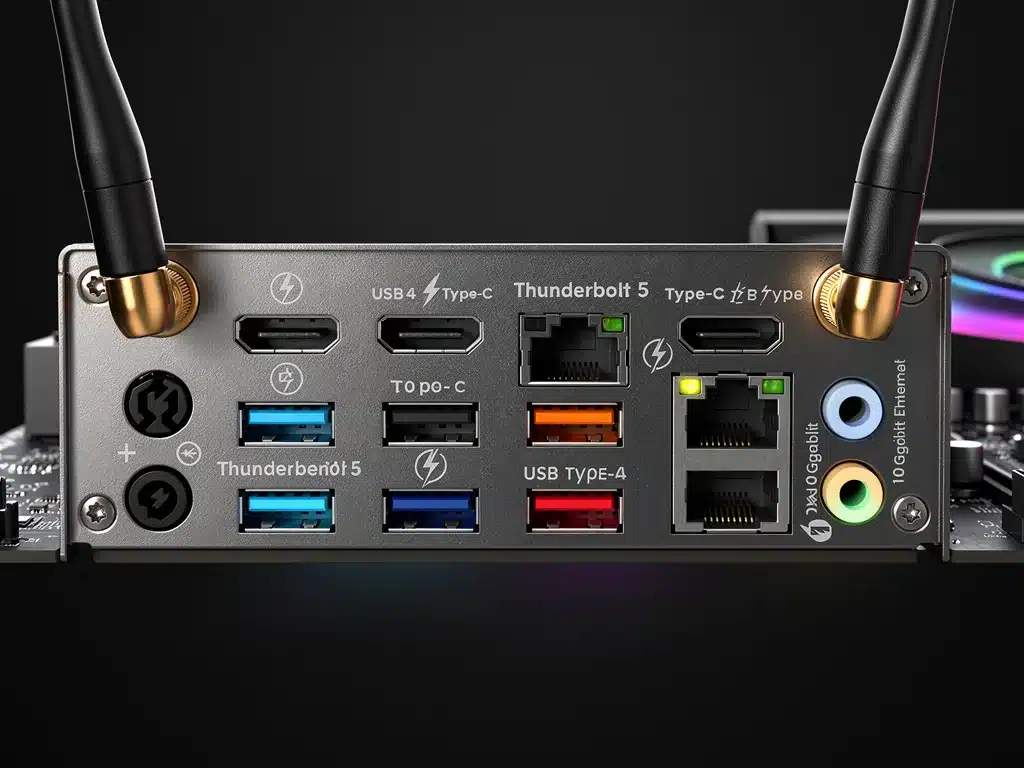
Connectivity extends beyond internal storage to external peripherals. Motherboards for Intel Core Ultra and AMD Ryzen 8000 Series Processors will integrate the latest USB standards, including USB 4 and potentially Thunderbolt 5.
These ports offer significantly higher bandwidth, enabling faster external storage, high-resolution display outputs, and versatile peripheral connections. The versatility of these ports is a major benefit for both gamers and content creators.
When evaluating Motherboard Selection 2026, consider the number and type of high-speed USB and Thunderbolt ports available, as they enhance overall system flexibility.
Next-Gen Networking: Wi-Fi 7 and 10 Gigabit Ethernet
Low latency and high bandwidth are paramount for online gaming. Motherboards in 2026 will come equipped with Wi-Fi 7 (802.11be) for wireless connectivity and 2.5 Gigabit or even 10 Gigabit Ethernet for wired connections.
Wi-Fi 7 offers substantial improvements in speed, capacity, and latency over previous generations, crucial for competitive online gaming.
10 Gigabit Ethernet provides unparalleled wired network performance for local file transfers and high-speed internet connections.
These networking features are essential for a cutting-edge gaming experience, making them a significant aspect of Motherboard Selection 2026 for any serious gamer.
Integrated Audio and Expansion Slots
While often overlooked, integrated audio solutions and the availability of expansion slots play a significant role in the overall user experience and system expandability. Motherboard Selection 2026 should consider these aspects for a well-rounded build.
High-quality integrated audio codecs, often paired with dedicated audio capacitors and isolated circuitry, can provide an excellent listening experience without the need for a separate sound card.
This is particularly beneficial for gamers using high-fidelity headphones.
Expansion slots, primarily PCIe slots, allow for the addition of graphics cards, capture cards, and other specialized hardware. Ensuring sufficient and correctly configured slots is vital for current and future upgrades.
High-Fidelity Integrated Audio
Modern motherboards feature advanced audio solutions, often leveraging codecs like Realtek ALC4080 or ESS SABRE DACs. These provide clearer audio output, better signal-to-noise ratios, and support for high-impedance headphones.
For gamers, superior audio can enhance immersion and provide a competitive edge through improved sound localization. Dedicated audio software suites often accompany these solutions, offering further customization.
Considering the integrated audio quality is a subtle yet important detail in Motherboard Selection 2026, impacting your daily gaming and media consumption.
PCIe Expansion Slots and Layout
Beyond the primary PCIe slot for the graphics card, motherboards offer additional slots for various expansion cards. For 2026, these will predominantly be PCIe Gen 4 or Gen 5, offering high bandwidth for future accessories.
The physical layout of these slots is important to prevent interference with large graphics cards or CPU coolers. The availability of multiple full-bandwidth slots can be crucial for users with multiple add-in cards.
When making your Motherboard Selection 2026, assess the number and type of PCIe expansion slots to ensure your current and future needs are met.
BIOS/UEFI and Software Ecosystem
The BIOS (Basic Input/Output System) or its modern equivalent, UEFI (Unified Extensible Firmware Interface), is the fundamental software that manages your motherboard and initializes hardware.
A well-designed BIOS/UEFI is crucial for ease of use, system stability, and performance tuning.
For Motherboard Selection 2026, look for intuitive UEFI interfaces that offer comprehensive control over CPU, memory, and power settings.
Regular and timely BIOS updates from manufacturers are also vital for supporting new hardware and resolving issues.
Beyond the BIOS, motherboard manufacturers provide software suites for monitoring, overclocking, and RGB lighting control. A robust software ecosystem enhances the overall user experience and system management.
User-Friendly UEFI Interface
A modern UEFI interface should be easy to navigate, offering both a simplified EZ Mode for beginners and an advanced mode for enthusiasts. Clear organization of settings, search functions, and built-in help features are highly desirable.
The ability to easily update the BIOS, often directly from the UEFI or via a USB flash drive, is a critical convenience feature. This ensures compatibility with future processors and memory modules.
An intuitive UEFI is a significant advantage in Motherboard Selection 2026, simplifying system configuration and troubleshooting.
Manufacturer Software Suites
Motherboard manufacturers offer proprietary software suites that provide additional functionality within the operating system.
These tools often include fan control, system monitoring, overclocking utilities, and RGB lighting synchronization.
While not universally essential, a well-developed software ecosystem can add value and convenience to your build. Look for suites that are regularly updated and offer a good balance of features and stability.
The quality of a manufacturer’s software support can influence your long-term satisfaction with your Motherboard Selection 2026, providing valuable utilities for system management.
Future-Proofing and Longevity
Investing in a new PC build, especially one featuring Intel Core Ultra or AMD Ryzen 8000 Series Processors, is a significant commitment.
Motherboard Selection 2026 should prioritize future-proofing to ensure your system remains relevant and upgradeable for years to come.
This involves considering not just current component compatibility but also potential future technologies and standards.
A motherboard with robust power delivery, ample expansion options, and support for the latest connectivity standards will offer greater longevity.
While no system can be entirely future-proof, making informed choices about key features can significantly extend the lifespan and upgrade potential of your gaming PC. This is a strategic decision for any builder.
Anticipating Future Standards
Beyond current standards, consider motherboards that hint at support for upcoming technologies. This could include preliminary support for PCIe Gen 6, even more advanced USB standards, or new memory types.
While speculative, some high-end motherboards often incorporate features that are slightly ahead of their time, offering a buffer against rapid technological obsolescence. This foresight is beneficial in Motherboard Selection 2026.
Looking at a motherboard’s potential for future upgrades is a smart strategy to maximize your investment and keep your system at the forefront of gaming technology.
Manufacturer Support and BIOS Updates
A motherboard is only as good as its ongoing support. Manufacturers with a strong track record of providing timely BIOS updates, driver support, and clear communication are highly desirable.
Regular BIOS updates are crucial for ensuring compatibility with new CPUs, memory modules, and addressing security vulnerabilities. This commitment to long-term support is a testament to the quality of a motherboard brand.
Researching a manufacturer’s reputation for support is a key aspect of Motherboard Selection 2026, guaranteeing a smoother experience throughout the lifespan of your PC.
Aesthetic Design and RGB Integration
For many gamers and PC enthusiasts, the aesthetic appeal of a motherboard is an important consideration.
While not directly impacting performance, the design, color scheme, and RGB lighting integration contribute to the overall look and feel of a custom build.
Motherboard Selection 2026 often involves balancing performance features with visual preferences. Manufacturers are increasingly incorporating sophisticated RGB lighting systems and sleek designs to cater to this demand.
While performance remains paramount, a visually appealing motherboard can significantly enhance the satisfaction of building and owning a custom gaming PC. It’s an aspect that adds personal flair to your setup.
RGB Lighting and Customization
Integrated RGB lighting zones on motherboards allow for extensive customization, synchronizing with other components like RAM, CPU coolers, and case fans.
Proprietary software suites manage these lighting effects, offering a wide array of patterns and colors.
Addressable RGB headers on the motherboard enable connection and control of external RGB strips and devices, further expanding lighting possibilities. This level of customization is highly valued by many builders.
If visual aesthetics are important to you, pay attention to the RGB features and integration options when making your Motherboard Selection 2026.
Form Factor and Layout
Motherboards come in various form factors, with ATX being the most common for gaming PCs, offering ample space for components and expansion. Smaller form factors like Micro-ATX and Mini-ITX cater to compact builds.
The physical layout of components on the motherboard, including fan headers, USB headers, and power connectors, can impact ease of installation and cable management. A well-thought-out layout simplifies the building process.
Consider the desired size of your PC case and the intended components when assessing the form factor and layout for your Motherboard Selection 2026.
| Key Feature | Importance for 2026 |
|---|---|
| CPU Socket & Chipset | Ensures compatibility with Intel Core Ultra or AMD Ryzen 8000, unlocks platform capabilities. |
| Robust VRM Design | Crucial for stable power delivery to high-performance CPUs, especially during overclocking. |
| PCIe Gen 5 NVMe | Essential for ultra-fast storage, maximizing game loading and data transfer speeds. |
| Wi-Fi 7 & 10GbE | Provides cutting-edge network performance for online gaming and high-speed data. |
Frequently Asked Questions About Motherboard Selection 2026
The most critical feature is CPU socket and chipset compatibility. Without the correct socket, your Intel Core Ultra or AMD Ryzen 8000 Series Processor simply won’t fit or function. The chipset then unlocks the full potential of these next-gen CPUs, enabling features like PCIe Gen 5 and advanced connectivity.
Yes, AMD has indicated a commitment to the AM5 socket for several generations. This means motherboards purchased now for Ryzen 7000 series are likely to support the upcoming Ryzen 8000 series with a BIOS update, offering excellent forward compatibility for your Motherboard Selection 2026.
DDR5 memory is already the standard and will be essential for maximizing the performance of Intel Core Ultra and AMD Ryzen 8000 Series Processors in 2026. Higher frequencies and improved efficiency offered by DDR5 directly benefit gaming frame rates and overall system responsiveness, making it a key consideration for Motherboard Selection 2026.
VRM quality is extremely important for next-gen processors. Intel Core Ultra and AMD Ryzen 8000 Series Processors demand robust and stable power delivery, especially under heavy loads or during overclocking. A high-quality VRM ensures consistent performance, prevents throttling, and contributes to the longevity of your CPU, making it a vital factor in Motherboard Selection 2026.
Prioritize PCIe Gen 5 NVMe slots for storage, advanced USB ports like USB4 or Thunderbolt 5 for peripherals, and next-gen networking such as Wi-Fi 7 and 2.5/10 Gigabit Ethernet. These features ensure lightning-fast data transfer, versatile peripheral support, and optimal online gaming experiences, crucial for any Motherboard Selection 2026.
Looking Ahead: The Impact of Motherboard Choices
The strategic decisions made during Motherboard Selection 2026: Key Features for Intel Core Ultra and AMD Ryzen 8000 Series Processors will profoundly impact the performance, longevity, and upgradeability of next-generation gaming PCs.
As hardware continues its rapid evolution, a well-chosen motherboard serves as the foundational element, dictating what is possible.
For a comprehensive breakdown on selecting the right platform and chipset for your build, check out the guide on How to Choose a Motherboard on Newegg Insider.
Users should closely monitor official announcements from Intel and AMD, along with motherboard manufacturers, for definitive specifications and feature sets as 2026 approaches.
These insights will refine understanding of optimal choices for specific use cases, ensuring alignment with the latest technological advancements.
Ultimately, a deep dive into the technical capabilities and future-proofing aspects discussed here will empower enthusiasts and builders to make informed decisions, guaranteeing their systems remain at the cutting edge of gaming technology for years to come.
The emphasis on robust power delivery, high-speed connectivity, and forward-compatible standards remains paramount.