Next-Gen Console Emulation on PC: 4K 60FPS by 2026
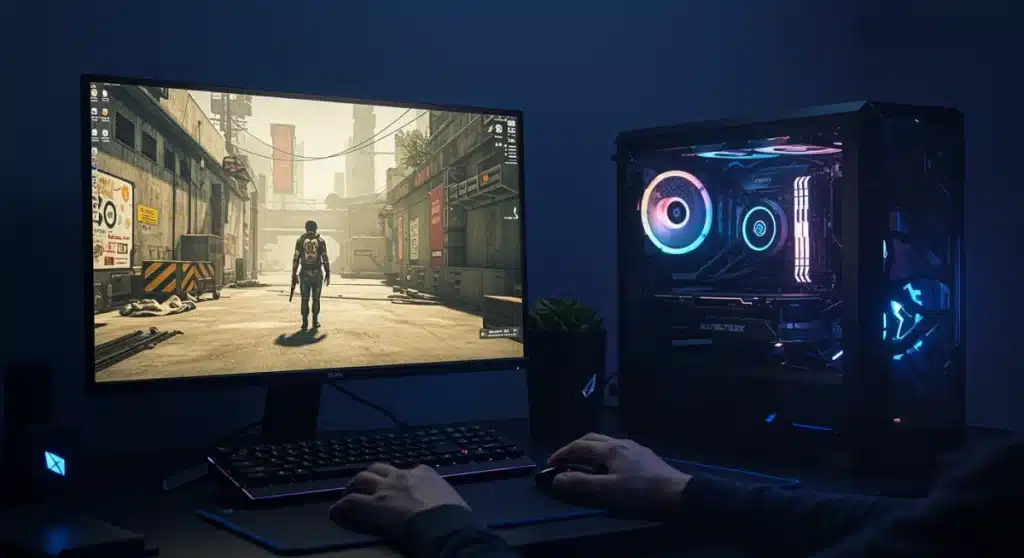
Achieving 4K 60FPS with next-gen console emulation on PC by late 2026 is becoming a tangible reality due to significant leaps in processor efficiency, graphics card capabilities, and the relentless progress of emulator development, promising an unparalleled gaming experience.
The dream of playing the latest console titles on your PC, not just at parity but often exceeding the original experience, is rapidly approaching reality. Specifically, the ability to achieve smooth 4K 60FPS with next-gen console emulation on PC by late 2026 is no longer a distant fantasy but a highly anticipated milestone, driven by relentless hardware innovation and the dedication of the emulation community.
Advertisements
The Emulation Landscape: A Historical Perspective
Console emulation has always been a race against time, a constant pursuit to replicate proprietary hardware and software environments on general-purpose computing platforms. From the early days of emulating 8-bit and 16-bit systems to the complex architectures of PlayStation 2 and Xbox 360, each generation presented unique challenges. The leap to modern consoles, with their intricate custom System-on-Chips (SoCs) and highly optimized game engines, initially seemed insurmountable.
However, the history of emulation shows a clear pattern: with enough time, computational power, and developer ingenuity, even the most formidable systems eventually yield. The current focus is on the PlayStation 5 and Xbox Series X/S, often referred to as next-gen consoles. These machines utilize AMD’s Zen 2 CPU architecture and RDNA 2 GPU architecture, albeit with significant customizations. Understanding this underlying hardware has been crucial for emulator developers.
Evolution of Emulation Techniques
Early emulators often relied on direct instruction translation, which was inefficient. Modern emulators employ a variety of advanced techniques to bridge the performance gap.
- Just-in-Time (JIT) Compilation: Translates console CPU instructions into PC-compatible instructions on the fly, significantly improving performance.
- Hardware Abstraction Layers: Emulators don’t directly mimic every component; instead, they create abstract layers that allow PC hardware to perform similar functions more efficiently.
- GPU Passthrough/Translation: Complex process of translating console GPU commands into PC GPU commands (e.g., DirectX/Vulkan), crucial for graphics rendering.
These techniques, combined with an ever-increasing understanding of console internals, lay the groundwork for high-fidelity emulation. The progress has been exponential, with new breakthroughs occurring regularly, pushing the boundaries of what was once thought impossible.
The journey of emulation is a testament to the open-source community’s power and collaborative spirit. Each generation brings new hurdles, but the collective knowledge and tools developed over decades continue to accelerate progress, making the prospect of widespread 4K 60FPS next-gen emulation a realistic goal within the next few years.
Hardware Requirements: What’s Needed for 4K 60FPS Emulation
Achieving 4K 60FPS in next-gen console emulation is a demanding task, pushing even high-end PC hardware to its limits. By late 2026, the ‘current hardware’ capable of this feat will likely represent the upper echelon of components available today and those released in the immediate future. This isn’t just about raw power; it’s also about architectural efficiency and specialized capabilities.
The primary bottlenecks in emulation are typically the CPU and GPU. Emulators often struggle to translate console-specific instructions and optimizations efficiently, leading to higher CPU overhead. Simultaneously, rendering games at 4K resolution with demanding graphical effects requires immense GPU horsepower, especially when coupled with the additional overhead of emulation itself.
Processor Power: The CPU is King
For emulation, single-core performance remains critical, but multi-core capabilities are increasingly important as emulators become more sophisticated in distributing workloads. Modern CPUs from Intel and AMD, particularly their high-end offerings, are essential. By late 2026, we anticipate CPUs with even higher core counts, improved instruction per cycle (IPC), and potentially dedicated AI acceleration cores that could aid in emulation tasks.
- High IPC and Clock Speeds: Crucial for handling the sequential nature of some emulation tasks.
- Multi-core Performance: Necessary for parallelizing various emulator processes, such as audio, input, and some rendering tasks.
- Large Cache: Helps reduce latency and speed up access to frequently used data, benefiting complex emulation workflows.
These advancements mean that a CPU released in late 2024 or 2025, still considered ‘current’ in late 2026, will likely possess the raw computational muscle needed to drive the CPU side of next-gen emulation at high frame rates.
Graphics Cards: The 4K Rendering Engine
The GPU’s role is straightforward: render the game at the desired resolution and frame rate. For 4K 60FPS, this demands a top-tier graphics card. Current flagship GPUs from Nvidia and AMD are already capable of 4K gaming in many native PC titles, but emulation adds another layer of complexity. By late 2026, we expect the next generations of GPUs to offer significant performance uplifts.
Features like enhanced ray tracing cores, more efficient memory architectures (e.g., GDDR7), and improved upscaling technologies (DLSS, FSR, XeSS) will be pivotal. These technologies can help alleviate the immense rendering burden, allowing for higher frame rates or better visual fidelity within the emulation environment.
In essence, a powerful and balanced PC system, featuring a high-end CPU and a cutting-edge GPU, will be the foundation for experiencing next-gen console emulation at its peak performance by the specified timeframe.
Software Innovations: The Role of Emulators
While hardware provides the raw power, it’s the software, specifically the emulators themselves, that translates that power into a playable experience. The advancements in emulator development are just as critical, if not more so, than hardware evolution. Emulator developers constantly optimize their code, reverse-engineer console functions, and implement new techniques to improve performance and accuracy.
For PlayStation 5 and Xbox Series X/S emulation, projects are still in their early stages, but the progress is noticeable. Developers are leveraging years of experience from previous console generations, applying lessons learned to these newer, more complex systems. The open-source nature of many emulation projects means a collaborative effort, with contributions from talented programmers worldwide.
Key Emulator Optimizations
Modern emulators don’t just brute-force their way through; they employ clever optimizations to minimize the performance overhead.
- Dynamic Recompilation: Continuously optimizes translated code based on runtime behavior, improving efficiency.
- Advanced Caching Mechanisms: Stores frequently translated code or data to avoid redundant processing.
- Multi-threading Optimizations: Distributes different emulation tasks across multiple CPU cores, taking advantage of modern CPU architectures.
These software-level enhancements are what allow less powerful hardware to emulate older systems and enable cutting-edge hardware to tackle the latest consoles. The development cycle for emulators is often long and arduous, but the community’s dedication ensures continuous progress.
The Importance of API Translation
Console games are developed using specific graphics APIs (e.g., PlayStation’s GNM, Xbox’s DirectX). PC GPUs, however, use standard APIs like DirectX, Vulkan, and OpenGL. Emulators must translate these console-specific calls into commands that a PC GPU can understand and execute. This translation layer introduces overhead but is essential for rendering. Advances in API translation efficiency, particularly with Vulkan, which offers lower overhead than older APIs, are crucial for achieving high frame rates in next-gen console emulation.
The ongoing refinement of emulators, coupled with improved understanding of console inner workings, will be the primary driver in unlocking 4K 60FPS experiences. The synergy between powerful hardware and optimized software is what makes this future achievable.
Challenges and Hurdles to Overcome
While the prospect of 4K 60FPS next-gen console emulation is exciting, it’s important to acknowledge the significant challenges that remain. Emulation is inherently difficult, and replicating complex, custom-designed hardware on a general-purpose PC introduces numerous hurdles that developers must meticulously overcome.
One of the primary challenges lies in the sheer complexity of modern console System-on-Chips (SoCs). Unlike older consoles which often had distinct CPU and GPU components, current-gen consoles integrate these tightly, along with custom memory controllers, I/O processors, and other specialized hardware. Emulating these tightly coupled systems with perfect fidelity and performance is an enormous undertaking.
Proprietary Hardware and Software
Both PlayStation and Xbox utilize proprietary technologies and optimizations that are not publicly documented. Reverse-engineering these components takes immense time and effort. This includes understanding custom instruction sets, memory management units, and security measures designed to prevent unauthorized access and protect intellectual property.
- Custom Instruction Sets: Deciphering and efficiently translating console-specific CPU instructions to x86/x64.
- Memory Management: Accurately simulating the console’s unified memory architecture and how the CPU and GPU share resources.
- DRM and Anti-Tampering: Overcoming digital rights management and anti-tampering measures without compromising the integrity of the emulation.
These proprietary elements create a constant cat-and-mouse game between console manufacturers and emulator developers, requiring continuous adaptation and innovation.
Performance Bottlenecks and Optimization
Even with powerful PC hardware, achieving perfect 1:1 performance can be difficult due to the overhead introduced by the emulation layer. Every instruction translated, every graphics call re-routed, adds a small delay. Accumulatively, these delays can prevent reaching native console performance, especially at higher resolutions and frame rates.
Optimizing emulators involves identifying these bottlenecks and finding clever ways to mitigate them. This could mean more efficient JIT compilers, better caching algorithms, or more intelligent resource management. The journey to 4K 60FPS is not just about raw power, but about squeezing every last drop of efficiency from both hardware and software.
Despite these challenges, the emulation community has a proven track record of overcoming seemingly impossible obstacles. The collective knowledge and dedication of developers worldwide continue to drive progress, making the 2026 target for high-fidelity next-gen console emulation increasingly plausible.
The Role of AI and Machine Learning in Emulation
The rapid advancements in Artificial Intelligence (AI) and Machine Learning (ML) are beginning to play a transformative role in various aspects of computing, and next-gen console emulation is no exception. While still an emerging field within emulation, AI/ML offers tantalizing possibilities for overcoming some of the most persistent challenges, particularly in areas like upscaling, performance optimization, and even code translation.
One of the most immediate applications of AI in emulation is intelligent upscaling. Technologies like NVIDIA’s DLSS, AMD’s FSR, and Intel’s XeSS already use AI to render games at a lower resolution and then intelligently upscale them to higher resolutions (like 4K) with minimal visual degradation, often looking better than native rendering due to anti-aliasing benefits. Integrating these into emulators could significantly reduce the GPU burden for 4K output.
AI-Enhanced Upscaling and Frame Generation
The ability of AI to generate frames or enhance existing ones can be a game-changer for achieving 4K 60FPS in emulation. If an emulator can only consistently hit, say, 40-50 FPS at 4K, AI frame generation could potentially interpolate additional frames to reach a smooth 60 FPS experience, making the difference between a choppy and a fluid game.
- Resolution Upscaling: AI models can intelligently reconstruct missing pixel data, turning a lower-resolution render into a crisp 4K image.
- Frame Interpolation: AI algorithms can analyze consecutive frames and generate plausible intermediate frames, effectively doubling or tripling frame rates.
- Texture Enhancement: AI can be trained to upscale and enhance low-resolution textures from older games, making them look native in a 4K environment.
These AI-powered techniques allow for a visual experience that exceeds what native console hardware can achieve, all while potentially reducing the computational load on the PC.
AI for Performance Optimization and Debugging
Beyond visual enhancements, AI could also aid in the core performance aspects of emulation. ML models could be trained to identify performance bottlenecks in real-time, suggesting dynamic optimizations or even automatically adjusting emulator settings for optimal performance on a given hardware configuration. Furthermore, in the complex world of debugging, AI could assist developers in pinpointing obscure bugs or inconsistencies between emulated behavior and native console behavior.
By late 2026, we anticipate more widespread integration of AI and ML into mainstream emulators, making the goal of 4K 60FPS next-gen console emulation not just about raw power, but about intelligent processing as well.
Future Outlook: Beyond 2026
Looking beyond late 2026, the trajectory for next-gen console emulation on PC suggests an even more robust and accessible future. The relentless march of technological progress in both hardware and software ensures that emulation capabilities will continue to expand, eventually making 4K 60FPS emulation not just achievable on high-end systems, but potentially on a broader range of mid-to-high-tier PCs.
The evolution of PC hardware will undoubtedly bring more efficient architectures, higher core counts, and more powerful integrated graphics solutions. This means that even entry-level dedicated GPUs and high-end integrated GPUs might eventually be capable of respectable emulation performance, further democratizing access to console game libraries on PC.
The Convergence of Hardware and Software
One significant trend expected to continue is the closer integration between hardware and software. CPU and GPU manufacturers are increasingly designing their chips with AI and ML accelerators, which, as discussed, can be leveraged by emulators. This hardware-level support for AI tasks will make features like AI upscaling and frame generation even more efficient and widespread.
- Increased Hardware Acceleration: More dedicated silicon for emulation-friendly tasks, such as instruction translation or graphics API handling.
- Cloud Emulation: The rise of cloud gaming could extend to cloud-based emulation, allowing users to stream emulated games without needing powerful local hardware.
- Broader Game Compatibility: As emulation matures, more and more games will become perfectly playable, with fewer bugs or graphical glitches.
The eventual goal for many in the emulation community is ‘perfect’ emulation – a state where games run identically, if not better, than on their native hardware, across a wide range of PC specifications.
The Sustainability of Emulation
As console generations cycle, emulation becomes increasingly important for game preservation. The ability to run older titles on modern hardware ensures that gaming history is not lost to obsolete formats. By making next-gen console emulation widely accessible and performant, the PC gaming community plays a crucial role in safeguarding these digital artifacts for future generations.
The future beyond 2026 promises a landscape where emulation is not just a niche pursuit but a mainstream way for PC gamers to experience a vast library of titles with unparalleled fidelity and flexibility.
Ethical and Legal Considerations in Emulation
While the technical aspects of next-gen console emulation are fascinating, it’s equally important to consider the ethical and legal frameworks surrounding this rapidly evolving field. Emulation exists in a somewhat gray area, often misunderstood by the general public and sometimes challenged by intellectual property holders. Understanding these nuances is crucial for anyone engaging with or supporting the emulation community.
The core principle that generally makes emulation legal is that emulators themselves do not contain proprietary code from the console manufacturer. They are reverse-engineered implementations of how the console functions. The legal issues typically arise when copyrighted console BIOS files or game ROMs are distributed without authorization.
Legality vs. Illegality
It’s generally accepted in many jurisdictions that creating an emulator through clean-room reverse engineering is legal. This means developers build the emulator without using any copyrighted code or assets from the original console. However, distributing copyrighted game images (ROMs) or console BIOS files is almost universally illegal without permission from the copyright holder.
- Emulator Development: Generally legal if developed independently without infringing copyrights.
- BIOS Files: Often considered copyrighted material; acquiring these legally usually involves dumping them from your own purchased console.
- Game ROMs/ISOs: Distributing or downloading copyrighted games without owning the original is illegal. Many argue that creating backups of games you own for personal use is fair use, but this varies by region.
The legal landscape is complex and varies significantly across different countries, making it a challenging area for both developers and users.
Ethical Responsibilities of the Community
Beyond the strict legal definitions, there are ethical considerations for the emulation community. Supporting legitimate game purchases, even for titles played via emulation, helps ensure that developers and publishers are compensated for their work. Promoting responsible practices, such as not distributing copyrighted material, strengthens the community’s standing and reduces legal risks.
As next-gen console emulation becomes more powerful and widespread, these ethical considerations will become even more prominent. Fostering a community that respects intellectual property while pushing the boundaries of technological possibility is vital for the long-term health and acceptance of emulation.
| Key Aspect | Description for 4K 60FPS Emulation by 2026 |
|---|---|
| Hardware Power | High-end CPUs (latest gen) and GPUs (RTX 40-series equivalent or newer) are crucial for handling 4K rendering and emulation overhead. |
| Emulator Development | Advanced JIT compilation, API translation, and multi-threading optimizations are key to efficient next-gen console emulation. |
| AI/ML Integration | AI upscaling (DLSS, FSR) and frame generation will significantly boost visual quality and achieve higher frame rates at 4K. |
| Challenges | Overcoming proprietary hardware, complex SoCs, and legal/ethical considerations remains a continuous effort. |
Frequently Asked Questions About Next-Gen Console Emulation
For consistent 4K 60FPS, you’ll likely need a high-end PC, ideally with components from 2024-2025 or newer, which would be considered ‘current’ by late 2026. This includes a powerful CPU and a top-tier GPU, as emulation is very demanding on both.
Key hurdles include reverse-engineering complex custom System-on-Chips (SoCs), efficiently translating proprietary console APIs to PC equivalents, and optimizing performance to overcome the inherent overhead of running a virtualized system. Security measures also add significant complexity.
AI and ML are expected to significantly enhance emulation through intelligent upscaling (like DLSS/FSR), frame generation for smoother gameplay, and potentially even optimizing emulator code in real-time. This can reduce hardware demands while improving visual fidelity and frame rates.
Developing emulators through clean-room reverse engineering is generally considered legal. However, distributing copyrighted console BIOS files or game ROMs without permission from the copyright holder is typically illegal. Users should always ensure they own the games they emulate.
Emulation efforts are underway for both PlayStation 5 and Xbox Series X/S. While still in early development stages, progress is being made, with some games already showing signs of booting. Full 4K 60FPS playability across a wide library is the ongoing goal for late 2026.
Conclusion
The landscape of next-gen console emulation on PC is evolving at an astonishing pace. The confluence of increasingly powerful PC hardware, sophisticated emulator development, and the burgeoning integration of AI and Machine Learning technologies paints a clear picture: achieving 4K 60FPS for the latest console titles on a capable PC by late 2026 is not just a possibility, but a highly probable reality. While challenges persist in overcoming proprietary architectures and ensuring legal compliance, the relentless dedication of the emulation community continues to push boundaries, promising an unprecedented era of gaming accessibility and visual fidelity for PC enthusiasts.