Wi-Fi 6E’s Latency Impact on PC Gaming: 2026 Analysis
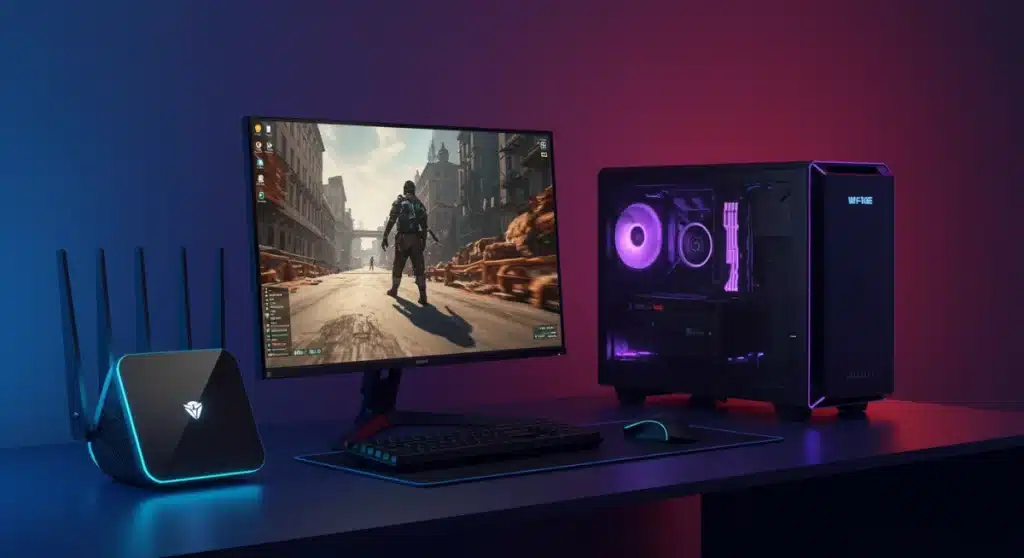
By 2026, Wi-Fi 6E significantly reduces PC gaming latency by utilizing the exclusive 6 GHz band, offering dedicated channels and mitigating interference for a smoother, more responsive competitive gaming experience.
Are you a serious PC gamer constantly battling frustrating lag and unpredictable connections? By 2026, the arrival and widespread adoption of Wi-Fi 6E on PC gaming latency has fundamentally reshaped the wireless gaming landscape, promising an era of unparalleled responsiveness and stability.
Advertisements
Understanding Wi-Fi 6E: The New Frontier for Wireless Gaming
Wi-Fi 6E represents a significant leap forward in wireless technology, extending the capabilities of Wi-Fi 6 into the previously untapped 6 GHz frequency band. This expansion is not merely about increasing bandwidth; it’s about unlocking a cleaner, less congested spectrum specifically beneficial for latency-sensitive applications like PC gaming. In 2026, this technology is no longer nascent but a standard feature in high-performance gaming setups.
The core advantage of Wi-Fi 6E lies in its exclusive use of the 6 GHz band. Unlike the crowded 2.4 GHz and 5 GHz bands, which are shared with countless other devices and older Wi-Fi standards, the 6 GHz band is a pristine, wide-open highway. This translates directly to reduced interference and greater channel availability, critical factors in achieving consistent, low-latency connections for gamers.
The 6 GHz Advantage
The introduction of the 6 GHz band brings several profound benefits to the table, particularly for PC gamers. This band offers up to 1200 MHz of contiguous spectrum, allowing for numerous 160 MHz channels. These wide channels are essential for high-throughput applications and, crucially, for minimizing packet loss and jitter.
- Reduced Congestion: Fewer devices competing for airtime means a clearer path for gaming data.
- Exclusive Spectrum: The 6 GHz band is reserved for Wi-Fi 6E and future standards, preventing interference from legacy devices.
- Wider Channels: Enables higher data rates and more efficient data transmission, which helps in reducing latency spikes.
In essence, Wi-Fi 6E provides a dedicated, high-speed lane for your gaming traffic, bypassing the digital roadblocks that often plague older Wi-Fi standards. This dedicated pathway ensures that your game data packets arrive swiftly and consistently, translating into a tangible reduction in in-game latency.
Latency Defined: Why Every Millisecond Matters in PC Gaming
Latency, in the context of PC gaming, refers to the delay between an action performed by the player and the corresponding response seen on screen or registered by the game server. It’s often measured in milliseconds (ms), and for competitive gamers, even a few milliseconds can mean the difference between victory and defeat. Understanding the various components that contribute to latency is crucial for appreciating Wi-Fi 6E’s impact.
Network latency, specifically, is the time it takes for data to travel from your gaming PC, through your router, to the game server, and back again. While fiber optic connections offer minimal latency over wired networks, wireless connections introduce additional variables. Traditional Wi-Fi bands are susceptible to interference, signal degradation, and channel congestion, all of which inflate network latency and create an inconsistent gaming experience.
Components of Gaming Latency
Gaming latency isn’t just one number; it’s a sum of several factors, each contributing to the overall delay you experience. Optimizing for low latency means addressing as many of these components as possible.
- Input Lag: Delay between physical input (mouse click, keyboard press) and action on screen.
- Display Latency: Time taken for the monitor to display the rendered frame.
- Network Latency (Ping): Time for data to travel to and from the game server. This is where Wi-Fi 6E makes a significant difference.
- Processing Latency: Time taken by the PC’s CPU/GPU to process game logic and render frames.
For PC gamers, minimizing network latency is paramount, especially in fast-paced competitive titles. A high ping can lead to desynchronization, rubber-banding, and missed shots, severely impacting gameplay. Wi-Fi 6E directly targets this critical component by providing a more stable and faster wireless conduit for data.
Wi-Fi 6E’s Technological Advancements Beyond 6 GHz
While the 6 GHz band is the headline feature, Wi-Fi 6E also incorporates other technological advancements inherited from Wi-Fi 6 that collectively contribute to its superior performance and reduced latency. These features work in conjunction with the new spectrum to create a robust and efficient wireless environment for gaming.
Orthogonal Frequency Division Multiple Access (OFDMA) is one such key innovation. It allows a single transmission to be divided into multiple smaller sub-channels, enabling multiple devices to transmit and receive data simultaneously on the same channel. This efficiency reduces wait times for data transmission, directly impacting latency. Target Wake Time (TWT) is another feature that helps in conserving power and optimizing network traffic by scheduling when devices wake up to send or receive data, further streamlining communication.
Key Wi-Fi 6E Features for Gamers
These features, though not exclusive to Wi-Fi 6E, are fully leveraged within the 6 GHz band, maximizing their benefits for latency-sensitive applications.
- OFDMA: Improves efficiency by allowing multiple users to share a channel, reducing latency for all connected devices.
- MU-MIMO (Multi-User, Multiple-Input, Multiple-Output): Enables routers to communicate with multiple devices simultaneously, rather than sequentially, boosting overall network capacity and reducing individual device wait times.
- 1024-QAM: A higher-order modulation scheme that allows for more data to be packed into each signal, increasing throughput.
These combined technologies create an intelligent and efficient wireless network that prioritizes data flow, minimizes bottlenecks, and ensures that gaming packets are delivered with minimal delay. The synergy between the clean 6 GHz band and these advanced protocols is what truly sets Wi-Fi 6E apart for PC gaming.
Real-World Performance: Benchmarks and User Experience in 2026
By 2026, extensive testing and widespread adoption have provided clear data on the real-world performance benefits of Wi-Fi 6E for PC gaming. Benchmarks consistently show a noticeable reduction in average latency and, perhaps more critically, a significant decrease in latency spikes, which are often more disruptive than a consistently high average ping.
User experiences corroborate these findings. Gamers upgrading to Wi-Fi 6E report a smoother, more consistent online experience, particularly in competitive titles where every millisecond counts. The days of random lag spikes causing frustrating losses are becoming less frequent for those utilizing the 6 GHz band, fostering a more enjoyable and fair gaming environment.
Comparative Latency Analysis
Comparing Wi-Fi 6E to previous standards like Wi-Fi 5 (802.11ac) and even Wi-Fi 6 (802.11ax) on the 5 GHz band reveals distinct advantages in a real-world gaming scenario. The dedicated 6 GHz spectrum eliminates much of the background noise and interference that plague older bands.
In competitive gaming scenarios, where a stable connection is paramount, the difference is stark. While a wired Ethernet connection still offers the absolute lowest and most consistent latency, Wi-Fi 6E closes the gap significantly, making wireless gaming a truly viable and highly competitive option for many players. The consistency it offers is arguably its greatest asset to gamers.
Optimizing Your Wi-Fi 6E Gaming Setup for Minimal Latency
While Wi-Fi 6E inherently offers superior latency performance, proper setup and optimization are crucial to fully harness its capabilities. Even the most advanced technology can be hampered by poor configuration or environmental factors. In 2026, understanding these optimization techniques is part of being a savvy PC gamer.
Ensuring your gaming PC has a compatible Wi-Fi 6E adapter is the first step. Many modern gaming motherboards and laptops now come with integrated Wi-Fi 6E, but older systems may require an upgrade. Positioning your Wi-Fi 6E router strategically, ideally in the same room as your gaming PC and away from obstructions, can also significantly improve signal strength and reduce latency.
Best Practices for Wi-Fi 6E Gaming
- Router Placement: Keep your router in an open area, centrally located, and as close to your gaming PC as possible.
- Dedicated 6 GHz Network: Ensure your gaming PC is connected to the 6 GHz SSID if your router broadcasts separate networks.
- Minimize Interference: Keep other high-bandwidth devices (like streaming media players) off the 6 GHz band if they don’t require its full speed, or ensure they are properly configured to coexist.
- Firmware Updates: Regularly update your router’s firmware and your PC’s Wi-Fi drivers to ensure optimal performance and access to the latest optimizations.
By following these best practices, gamers can ensure they are getting the absolute best out of their Wi-Fi 6E setup, translating into the lowest possible wireless latency and a consistently smooth gaming experience. It’s about creating an optimized ecosystem for your high-performance gaming.
The Future Beyond Wi-Fi 6E: What’s Next for Gaming Connectivity?
As we look beyond 2026, the evolution of wireless technology continues at a rapid pace. While Wi-Fi 6E has set a new standard for low-latency wireless gaming, the development of Wi-Fi 7 (802.11be, also known as Extremely High Throughput or EHT) is already underway, promising even greater advancements. Wi-Fi 7 aims to push the boundaries of speed and efficiency even further, building upon the foundation laid by Wi-Fi 6E.
Wi-Fi 7 is expected to introduce features like Multi-Link Operation (MLO), which allows devices to simultaneously send and receive data across different frequency bands (2.4 GHz, 5 GHz, and 6 GHz). This capability could dramatically increase throughput and reduce latency by aggregating bandwidth and dynamically switching between bands to ensure the most stable and fastest connection. This multi-band approach promises unprecedented levels of reliability and speed, further blurring the lines between wired and wireless performance.
Upcoming Wireless Innovations
The continuous innovation in wireless standards suggests that the future of PC gaming connectivity will be increasingly wireless, offering performance that rivals or even surpasses traditional wired connections in many scenarios.
- Multi-Link Operation (MLO): Enables simultaneous use of multiple frequency bands for enhanced speed and reliability.
- Preamble Puncturing: Allows for more efficient use of spectrum by skipping busy parts of a channel, reducing latency.
- Higher Order QAM (4096-QAM): Further increases data density, leading to even greater theoretical throughput.
These future developments indicate a clear trajectory towards even lower latency, higher bandwidth, and more robust wireless connections. For PC gamers, this means an even greater freedom from cables without compromising on the critical performance aspects required for competitive play. The wireless frontier for gaming is only just beginning to unfold its full potential.
| Key Aspect | Impact on Gaming Latency |
|---|---|
| 6 GHz Band | Dedicated, uncongested spectrum significantly reduces interference and packet loss. |
| OFDMA & MU-MIMO | Enhance network efficiency, allowing simultaneous data transmission and lowering wait times. |
| Wider Channels | Enables higher data rates and more efficient data transfer, minimizing latency spikes. |
| User Experience | Results in smoother, more consistent competitive gameplay with reduced lag. |
Frequently Asked Questions About Wi-Fi 6E and Gaming
While Wi-Fi 6E significantly reduces wireless network latency and minimizes lag spikes, it cannot eliminate all forms of lag. Factors like server-side latency, internet service provider performance, and PC hardware limitations still contribute. However, it drastically improves the wireless component of network lag.
By 2026, Wi-Fi 6E routers have become more mainstream and affordable. While high-end models can still be costly, there are many mid-range options that offer excellent performance for gamers. The investment is often justified by the improved gaming experience and future-proofing.
Yes, to fully leverage the benefits of Wi-Fi 6E, both your router and your PC’s wireless adapter must support the standard and operate on the 6 GHz band. Without a Wi-Fi 6E compatible adapter in your PC, you won’t be able to connect to the dedicated 6 GHz network.
Wi-Fi 6E, like Wi-Fi 6, utilizes technologies such as OFDMA and MU-MIMO. These allow the router to communicate more efficiently with multiple devices simultaneously across the 6 GHz band. This means your gaming PC won’t be as impacted by other devices streaming or browsing.
Wi-Fi 6E primarily enhances both speed (throughput) and latency. The wider, uncongested 6 GHz channels allow for faster data transfer, which translates to higher theoretical speeds. More importantly for gamers, the reduced interference and efficient protocols lead to a more stable and lower latency connection.
Conclusion
By 2026, the transformative impact of Wi-Fi 6E on PC gaming latency is undeniable. The introduction of the pristine 6 GHz band, coupled with advanced Wi-Fi 6 technologies, has delivered a wireless gaming experience that is remarkably close to, and in some aspects even rivals, a wired connection. Gamers now have the freedom to enjoy competitive titles without the shackles of Ethernet cables, benefiting from significantly reduced ping, fewer latency spikes, and an overall more consistent and responsive gameplay. As technology continues to evolve with standards like Wi-Fi 7 on the horizon, the future of wireless PC gaming looks increasingly bright, promising even greater speeds and lower latencies for the discerning player.