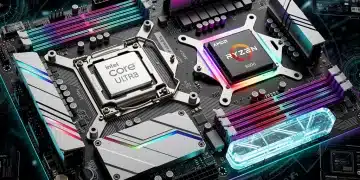
Future-Proofing Your Gaming PC: Key Hardware for 2026 and Beyond
To ensure your gaming PC remains competitive in 2026 and beyond, prioritize robust core components like the CPU, GPU, and high-speed storage, alongside a forward-compatible motherboard for sustained performance.
Are you looking to build or upgrade a gaming PC that won’t feel outdated in just a couple of years? The journey to future-proof gaming PC involves strategic hardware choices that anticipate technological advancements, ensuring your rig handles upcoming titles with ease.
Advertisements
The evolving landscape of gaming hardware
The world of PC gaming hardware is in constant flux, with new technologies emerging at an astonishing pace. What constitutes a high-end system today might be mid-range tomorrow. Understanding these trends is crucial for anyone aiming to build a system that can withstand the test of time, running future games without immediate upgrades.
Developers are continually pushing graphical fidelity and computational demands, driven by advancements in rendering techniques like ray tracing and path tracing, alongside more complex AI and physics simulations. This necessitates a proactive approach to component selection, focusing on headroom and architectural longevity rather than just current performance benchmarks.
Anticipating next-gen gaming demands
Future games are expected to leverage more cores, faster memory, and significantly more powerful graphics processing. Virtual reality (VR) and augmented reality (AR) experiences are also becoming more demanding, requiring sustained, high frame rates and resolutions. Content creation, often intertwined with high-end gaming, also benefits from robust hardware. Therefore, choosing components with a generous performance buffer is not just a luxury but a necessity for longevity.
- Increased reliance on multi-core CPUs for complex game logic and background tasks.
- Higher VRAM capacities on GPUs to handle ultra-high resolution textures and advanced rendering effects.
- Faster storage solutions to minimize loading times and support direct asset streaming.
- More efficient power delivery and cooling systems to sustain peak performance.
In conclusion, the future of gaming demands hardware that is not only powerful today but also capable of adapting to the innovations of tomorrow. This means looking beyond current benchmarks and considering the architectural foundations of each component.
Central processing unit (CPU): The brain of your operation
The CPU is the fundamental command center of your gaming PC, orchestrating all operations from game logic to AI processing. While GPUs often steal the spotlight for gaming performance, a powerful CPU is indispensable for smooth gameplay, especially in CPU-intensive titles and multitasking scenarios. For 2026 and beyond, the focus shifts towards higher core counts, excellent single-core performance, and efficient architectures.
Modern gaming increasingly leverages multiple CPU cores, particularly in open-world titles and strategy games. Future games are expected to further distribute workloads across more cores, making high core and thread counts more critical than ever. However, single-core performance remains vital for tasks that cannot be easily parallelized, such as core game loops and physics calculations.
Key CPU considerations for future-proofing
When selecting a CPU, look for models with at least 8 cores and 16 threads, as this provides a solid foundation for upcoming software. Intel’s latest i7/i9 series or AMD’s Ryzen 7/9 processors are excellent starting points. Consider their platform longevity; a newer socket type might offer more upgrade paths down the line without needing a new motherboard.
- Core Count: Aim for 8+ cores for multitasking and future game demands.
- Clock Speed: High single-core clock speeds are still crucial for gaming responsiveness.
- Architecture: Newer architectures often bring significant IPC (instructions per cycle) improvements, which translate to better performance even at similar clock speeds.
The integration of AI accelerators within CPUs, like Intel’s NPU or AMD’s XDNA, is also an emerging trend. While their direct impact on gaming is currently limited, they could become more relevant for in-game AI or performance-enhancing features in the future. Investing in a CPU with these capabilities could offer an unexpected edge.
In summary, a balanced approach to CPU selection, prioritizing both high core counts and strong single-core performance on a modern platform, will ensure your system remains capable for years to come.
Graphics Processing Unit (GPU): The visual powerhouse
Without a doubt, the GPU is the most critical component for gaming performance, directly impacting frame rates, resolution capabilities, and graphical fidelity. As games become visually more stunning and demanding, a powerful GPU is the cornerstone of any future-proof gaming PC. The landscape for 2026 and beyond points towards even higher VRAM capacities, advanced rendering technologies, and improved power efficiency.
Ray tracing and path tracing, once niche features, are becoming more prevalent and sophisticated, demanding immense computational power. Upscaling technologies like NVIDIA’s DLSS and AMD’s FSR are also evolving rapidly, offering significant performance boosts without major compromises in image quality. Future GPUs will integrate these technologies more deeply and efficiently.
VRAM and architectural advancements
The amount of VRAM (Video RAM) on your GPU is increasingly important, especially for gaming at higher resolutions (1440p, 4K) and with high-resolution texture packs. Aim for at least 16GB of VRAM for a truly future-proof experience, as 8GB or even 12GB may become a bottleneck sooner than expected. NVIDIA’s RTX 40-series and AMD’s RX 7000-series GPUs are current benchmarks, but future generations will undoubtedly bring substantial improvements.
- VRAM Capacity: Target 16GB+ for 1440p/4K gaming in 2026 and beyond.
- Ray Tracing Cores: Enhanced dedicated hardware for ray tracing will be essential.
- Upscaling Technology: Support for the latest DLSS/FSR versions for performance gains.
Power efficiency is another area of continuous improvement. Future GPUs are expected to deliver more performance per watt, reducing heat output and power consumption, which benefits overall system stability and acoustics. Furthermore, advancements in GPU architectures will likely bring even more specialized cores for AI and machine learning, potentially impacting how games are rendered or even how in-game AI behaves.
Ultimately, investing in the highest-tier GPU you can reasonably afford, with a strong emphasis on VRAM and support for cutting-edge rendering techniques, is the single most impactful decision for future-proofing your gaming experience.
RAM (Random Access Memory): Speed and capacity
RAM plays a crucial role in the responsiveness and multitasking capabilities of your gaming PC. While often overshadowed by the CPU and GPU, insufficient or slow RAM can bottleneck even the most powerful components. For a system designed for 2026 and beyond, both the quantity and speed of RAM are paramount, with DDR5 becoming the standard and future iterations on the horizon.
Modern games, especially open-world titles and those with extensive assets, can consume significant amounts of RAM. Running multiple applications in the background, such as Discord, web browsers, or streaming software, further increases this demand. Future games will likely push these requirements even higher, making a generous amount of fast RAM a wise investment.
DDR5 and beyond: The memory frontier
DDR5 RAM is now the mainstream choice, offering significantly higher speeds and bandwidth compared to its DDR4 predecessor. For future-proofing, 32GB of DDR5 RAM should be considered the sweet spot. While 16GB might suffice for many games today, 32GB provides ample headroom for more demanding titles, content creation, and general system longevity. Look for kits with speeds of 6000MT/s or higher and low CAS latency.
- Capacity: 32GB of RAM is the recommended minimum for future-proofing.
- Speed: DDR5-6000MT/s or faster with optimized timings.
- Dual Channel: Always install RAM in matched pairs to utilize dual-channel memory architecture for improved bandwidth.
Beyond DDR5, memory technologies are continually evolving. While DDR6 is still some years away from consumer markets, ensuring your motherboard supports the latest DDR5 standards with multiple slots provides flexibility for future upgrades. The performance gains from faster RAM can translate into smoother frame rates and reduced stuttering, particularly in CPU-bound scenarios.
In conclusion, don’t underestimate the importance of RAM. A generous amount of high-speed DDR5 memory will ensure your system can handle the memory demands of future games and applications without compromise.
Storage solutions: NVMe SSDs are non-negotiable
Gone are the days when traditional hard disk drives (HDDs) were acceptable for gaming. For a truly future-proof gaming PC, NVMe Solid State Drives (SSDs) are not just recommended, but essential. Their unparalleled speed dramatically reduces loading times, game installation times, and overall system responsiveness. The trend for 2026 and beyond is towards even faster NVMe generations and larger capacities.
DirectStorage technology, pioneered by Microsoft, allows games to load assets directly from the NVMe SSD to the GPU, bypassing the CPU, which significantly reduces loading screens and allows for more detailed game worlds. This technology is becoming a standard feature in new game engines, making fast NVMe storage a critical component for optimal performance.
PCIe Gen 4 and Gen 5: The speed race
For current future-proofing, a PCIe Gen 4 NVMe SSD is the minimum recommendation, offering read/write speeds significantly higher than SATA SSDs. However, for true longevity, investing in a PCIe Gen 5 NVMe SSD, if your motherboard supports it, would be ideal. These drives offer double the bandwidth of Gen 4, providing even faster data access, which will be increasingly important as DirectStorage and similar technologies mature.
- Primary Drive: A 1TB or 2TB PCIe Gen 4 NVMe SSD for your operating system and primary games.
- Secondary Storage: Additional NVMe SSDs (Gen 4 or Gen 5) for your ever-growing game library.
- Capacity: Aim for at least 2TB of total NVMe storage, with 4TB being ideal for enthusiasts.
The physical size and form factor of NVMe drives (M.2) allow for compact and efficient storage solutions. Ensure your motherboard has multiple M.2 slots, preferably with heatsinks, to accommodate future storage expansion and maintain optimal drive temperatures. The days of mechanical drives for primary gaming storage are truly over; NVMe SSDs represent a fundamental shift in PC performance.
To summarize, high-speed NVMe SSDs, particularly those utilizing PCIe Gen 4 or Gen 5, are paramount for a future-proof gaming experience, ensuring rapid loading times and seamless asset streaming in next-generation titles.
Motherboard and connectivity: The backbone of your build
The motherboard might not directly impact frame rates, but it is the central nervous system that connects all your components and dictates the upgrade path of your system. For future-proof gaming PC builds targeting 2026 and beyond, selecting a motherboard with robust power delivery, advanced connectivity, and support for the latest standards is crucial. It ensures compatibility with upcoming hardware and leverages new technologies.
A high-quality motherboard provides stable power delivery to the CPU, crucial for maintaining boost clocks and overclocking stability. It also offers the necessary slots and ports for high-speed RAM, multiple NVMe SSDs, and advanced peripherals. Skimping on the motherboard can limit your system’s potential and necessitate an earlier upgrade than anticipated.
Essential features for longevity
Look for motherboards with the latest chipset that supports your chosen CPU generation, such as Intel’s Z790/Z890 or AMD’s X670/X870 chipsets. Ensure it features multiple PCIe Gen 5 M.2 slots for future-generation NVMe SSDs and at least one PCIe Gen 5 x16 slot for the graphics card, even if current GPUs only utilize Gen 4. USB 4.0 (Thunderbolt 4 compatible) and 2.5GbE or 10GbE LAN are also highly desirable for future-proofing connectivity.
- Latest Chipset: Supports current and potentially next-gen CPUs on the same socket.
- PCIe Gen 5: Essential for future GPUs and NVMe SSDs.
- Advanced USB: USB 4.0/Thunderbolt 4 for high-speed external devices.
- Networking: 2.5GbE or 10GbE LAN for ultra-fast wired internet.
- Wi-Fi 7: For cutting-edge wireless connectivity.
Another often overlooked aspect is the motherboard’s VRM (Voltage Regulator Module) design. A robust VRM with sufficient power phases and effective cooling ensures stable power delivery to the CPU, even under heavy loads or during overclocking, contributing to system stability and longevity. Audio solutions are also advancing, with many modern motherboards featuring high-quality integrated audio codecs and dedicated headphone amplifiers.
In essence, a well-chosen motherboard provides the foundation for a durable and adaptable gaming rig, allowing you to integrate future components and leverage emerging technologies without needing a complete system overhaul.
Power supply (PSU) and cooling: Sustaining performance
While less glamorous than CPUs or GPUs, the power supply unit (PSU) and cooling system are absolutely vital for the stability, longevity, and performance of a future-proof gaming PC. An underpowered or inefficient PSU can lead to instability and component degradation, while inadequate cooling can result in thermal throttling, reducing performance and shortening component lifespans. For 2026 and beyond, these components must be robust and forward-thinking.
As CPUs and GPUs become more powerful, their power consumption tends to increase, especially under load. This necessitates a PSU with ample wattage and high efficiency. Similarly, increased power means more heat generation, making a high-performance cooling solution a non-negotiable aspect for maintaining optimal operating temperatures and preventing performance dips.
Wattage, efficiency, and advanced cooling
For a high-end future-proof build, a PSU with at least 850W to 1000W and an 80 PLUS Gold or Platinum certification is a sensible choice. This provides sufficient headroom for current and future power-hungry components, as well as potential overclocking. Modular PSUs are also recommended for easier cable management and improved airflow. Look for ATX 3.0 compatible PSUs, which are designed for the transient power spikes of modern GPUs.
- PSU Wattage: 850W-1000W+ for high-end future builds.
- Efficiency Rating: 80 PLUS Gold or Platinum for better energy efficiency and less heat.
- Cooling Type: High-performance air coolers or 240mm/360mm AIO liquid coolers for CPUs.
- Case Airflow: A case with excellent airflow and multiple fan mounting options is crucial.
For cooling, high-end air coolers are still very effective for many CPUs, but for top-tier processors, particularly those that are overclocked, a 240mm or 360mm All-In-One (AIO) liquid cooler is often preferred. Ensure your PC case has good airflow characteristics, with plenty of fan mounting points, to facilitate efficient heat dissipation from all components. Proper cable management also plays a role in maintaining good airflow within the case.
Ultimately, investing in a high-quality, high-wattage, and efficient PSU, coupled with an effective cooling solution, safeguards your valuable components and ensures your future-proof gaming PC operates reliably and at peak performance for many years.
Future-proofing beyond hardware: Software and ecosystem
While hardware is undeniably the backbone of any future-proof gaming PC, software and the broader ecosystem play an equally critical, though often overlooked, role in a system’s longevity. A powerful rig can only perform as well as its software allows, and staying current with operating systems, drivers, and gaming platforms is paramount for sustained performance and compatibility in 2026 and beyond.
Operating systems like Windows 11 are continually updated to optimize for new hardware features, such as DirectStorage and advanced scheduling for hybrid CPU architectures. Keeping your OS up-to-date ensures you benefit from the latest performance enhancements, security patches, and compatibility improvements for new games and applications.
Drivers, APIs, and platform choices
Regularly updating GPU drivers from NVIDIA, AMD, or Intel is crucial. These updates often include performance optimizations for new game releases, bug fixes, and support for emerging technologies. Outdated drivers can severely impact gaming performance and even lead to compatibility issues. Similarly, keeping your motherboard chipset drivers updated ensures optimal communication between all your components.
- Operating System: Stay updated with the latest Windows versions (e.g., Windows 11 and its successors).
- GPU Drivers: Regularly update drivers for performance gains and bug fixes.
- APIs: Ensure support for DirectX 12 Ultimate, Vulkan, and future graphics APIs.
- Gaming Platforms: Utilize platforms like Steam, Epic Games Store, and Xbox Game Pass for access to a vast and evolving library.
The choice of gaming platforms and ecosystems also influences future-proofing. Digital storefronts like Steam and Epic Games Store offer vast libraries and ongoing support, while subscription services like Xbox Game Pass provide access to hundreds of titles. Ensuring your system is compatible with these platforms and can run their respective launchers smoothly is part of the overall future-proofing strategy.
In conclusion, a holistic approach to future-proofing involves not just selecting cutting-edge hardware, but also diligently maintaining and updating your software ecosystem. This synergy ensures that your powerful gaming PC operates at its peak potential for years to come, adapting to the ever-changing demands of the gaming world.
| Component | Future-Proofing Recommendation |
|---|---|
| CPU | 8+ cores, high single-core performance, modern socket. |
| GPU | 16GB+ VRAM, advanced ray tracing, latest upscaling support. |
| RAM | 32GB DDR5-6000MT/s or faster. |
| Storage | PCIe Gen 4/Gen 5 NVMe SSDs (2TB+ total). |
Frequently asked questions about future-proofing gaming PCs
The GPU is arguably the most crucial component. Investing in a high-end graphics card with ample VRAM and support for advanced rendering technologies like ray tracing and upscaling will provide the biggest performance gains and longevity for upcoming game titles.
While 16GB of RAM might be sufficient for many games today, for true future-proofing in 2026 and beyond, 32GB of DDR5 RAM is highly recommended. This capacity provides ample headroom for more demanding games, multitasking, and emerging applications.
For gaming, the GPU generally has a greater impact on frame rates and visual fidelity. However, a balanced approach is best. A powerful GPU paired with a capable multi-core CPU ensures smooth gameplay and avoids bottlenecks in CPU-intensive scenarios.
NVMe SSDs offer superior speed compared to traditional drives, drastically reducing loading times and improving overall system responsiveness. Technologies like DirectStorage, which leverage NVMe speeds for faster asset streaming, make them indispensable for next-generation gaming experiences.
The motherboard is the foundation of your PC. A high-quality motherboard with a modern chipset, robust power delivery, and support for advanced connectivity like PCIe Gen 5 and USB 4.0 ensures compatibility with future components and provides vital upgrade paths, extending your system’s lifespan.
Conclusion
Building a future-proof gaming PC for 2026 and beyond is an investment in sustained performance and enjoyment. It requires a thoughtful approach to hardware selection, prioritizing components that not only meet today’s demands but also anticipate tomorrow’s innovations. By focusing on powerful multi-core CPUs, high-VRAM GPUs, ample and fast DDR5 RAM, lightning-fast NVMe SSDs, and a feature-rich motherboard, you create a robust foundation that can adapt to the ever-evolving landscape of PC gaming. Remember that software updates and proper cooling are equally crucial in maximizing the lifespan and performance of your cutting-edge rig, ensuring countless hours of immersive gameplay for years to come.