Cooling High-End CPUs: AIO Liquid vs. Air Towers 2026
For high-end CPU cooling 2026, the choice between AIO liquid coolers and air towers hinges on a nuanced balance of performance, acoustics, aesthetics, and long-term reliability, directly impacting system stability and longevity.
In the demanding world of high-performance computing, keeping your CPU cool is paramount. Whether you’re a hardcore gamer, a professional content creator, or an enthusiast pushing the limits of overclocking, effective high-end CPU cooling 2026 is non-negotiable. As processors become more powerful and generate more heat, the debate between All-in-One (AIO) liquid coolers and traditional air towers continues to evolve. But which solution truly stands out in 2026 for delivering optimal thermal management and overall value?
Advertisements
The evolving landscape of CPU cooling in 2026
The year 2026 brings with it advancements in both CPU architecture and cooling technology. Processors from Intel and AMD are more efficient but also capable of drawing significant power under load, necessitating advanced thermal solutions.
Understanding these shifts is crucial before diving into specific cooler types.
Modern CPUs, especially flagship models, incorporate sophisticated boost algorithms that allow them to dynamically increase clock speeds as long as thermal headroom exists. This behavior makes a robust cooling solution not just about preventing overheating, but about unlocking maximum sustained performance. The better your cooler, the longer your CPU can operate at peak frequencies, directly translating to higher frame rates in games or faster render times in productivity applications.
Technological innovations shaping the market
- Advanced fin designs: Air coolers are seeing innovations in fin density and heat pipe configurations for improved heat dissipation.
- Pump and radiator efficiency: AIOs benefit from more efficient pumps, larger radiators, and improved fan designs that move more air with less noise.
- Smart control systems: Both types of coolers increasingly integrate with motherboard software for precise fan and pump speed control based on real-time thermal data.
Furthermore, the integration of AI-driven fan curves and predictive thermal management is becoming more common, allowing coolers to anticipate temperature spikes and adjust proactively. This level of intelligent control ensures quieter operation during light loads and aggressive cooling when performance demands it. The competition is fierce, driving innovation across the board.
In conclusion, the 2026 cooling market is characterized by a drive towards higher efficiency and smarter operation. Both AIO liquid coolers and air towers have adapted to these demands, offering compelling solutions that push the boundaries of what’s possible in thermal management for high-end CPUs. The choice is less about inherent superiority and more about specific user needs and system requirements.
AIO liquid coolers: performance and aesthetics
All-in-One (AIO) liquid coolers have surged in popularity, largely due to their compelling blend of high performance and sleek aesthetics. These closed-loop systems offer a convenient way to harness the superior heat transfer properties of liquid cooling without the complexities of custom loops.
In 2026, AIOs typically feature larger radiators, often up to 420mm, paired with high static pressure fans designed for optimal airflow through dense fins. The liquid coolant, propelled by an integrated pump, efficiently transfers heat from the CPU cold plate to the radiator, where it’s expelled by fans. This method generally allows for superior heat dissipation compared to air coolers, especially under heavy, sustained loads like those found in professional rendering or prolonged gaming sessions with high-end CPUs.
Key advantages of AIO liquid cooling
- Superior thermal performance: Often provides lower temperatures for high wattage CPUs, especially when overclocked.
- Compact CPU area: Keeps the area around the CPU socket clear, allowing for better airflow over RAM and VRMs.
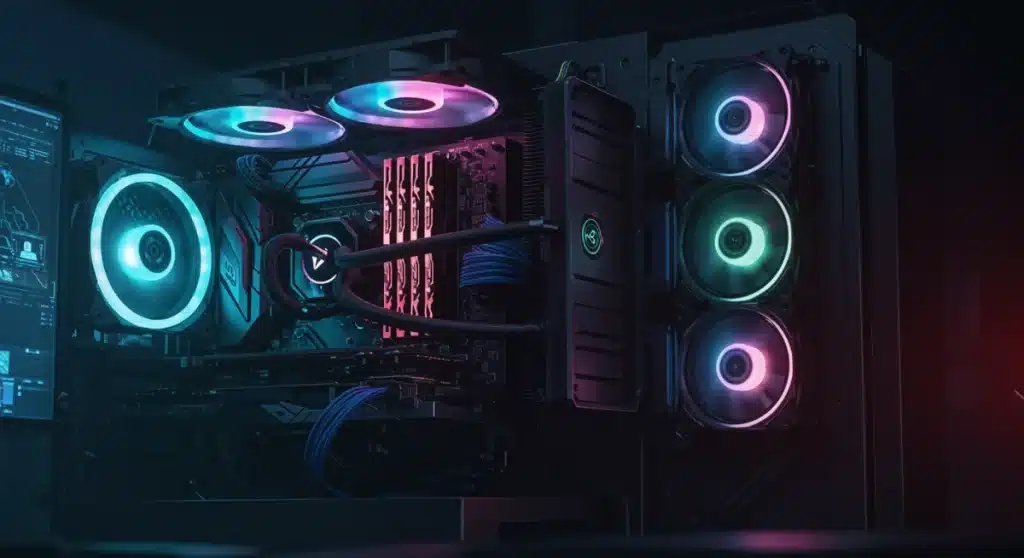
- Aesthetic appeal: Offers a cleaner look with less clutter, often featuring customizable RGB lighting on the pump block and fans.
Beyond raw performance, the aesthetic impact of an AIO is undeniable. The absence of a large heatsink tower directly over the CPU allows for a clearer view of the motherboard and RAM, which is often a significant factor for builders focusing on visual appeal. Many AIOs also come with addressable RGB lighting, allowing for extensive customization to match any build theme. This combination of form and function makes them a favorite for many enthusiasts.
However, AIOs are not without their considerations. They typically carry a higher price tag than their air cooling counterparts and introduce more points of failure due to the pump and liquid components. Despite these factors, for those prioritizing maximum thermal performance and a clean, modern aesthetic, AIO liquid coolers remain a top choice for high-end systems in 2026.
Air tower coolers: reliability and value
Air tower coolers have been the workhorses of CPU cooling for decades, and in 2026, they continue to offer a compelling solution, particularly for those prioritizing reliability, value, and straightforward installation. These coolers rely on heat pipes to transfer heat from the CPU to a large heatsink, which is then dissipated by one or more fans.
The fundamental design of air coolers, while seemingly simple, has undergone continuous refinement. Modern air towers boast increasingly sophisticated heat pipe designs, denser fin arrays, and highly optimized fan blades that push significant amounts of air quietly. While they might not always match the absolute peak thermal performance of the largest AIOs, the gap has narrowed significantly, especially with dual-tower, dual-fan configurations.
Benefits of choosing an air tower cooler
- Exceptional reliability: Fewer moving parts (only fans) mean fewer potential points of failure compared to AIOs.
- Lower cost: Generally more affordable, offering excellent performance per dollar.
- No pump noise: Eliminates the potential for pump whine, contributing to a quieter overall system.
One of the most significant advantages of air coolers is their inherent reliability. Without a pump or liquid, the risk of leaks or pump failure is non-existent. This makes them a ‘set it and forget it’ solution that can last for many years without maintenance beyond occasional dust cleaning. Furthermore, their lower cost makes them an attractive option for budget-conscious builders who still demand high-end cooling performance.
While they can be physically large and sometimes interfere with tall RAM modules or certain case side panels, the trade-offs often justify the choice. For users seeking a robust, long-lasting, and cost-effective cooling solution that performs admirably with high-end CPU cooling 2026, air towers remain a formidable contender.
Installation and compatibility considerations
Beyond raw performance, the practical aspects of installation and compatibility play a significant role in choosing between AIO liquid coolers and air towers. A smooth installation process and ensuring proper fitment within your PC case are critical for any build.
AIO liquid coolers generally offer more flexibility around the CPU socket itself, as the pump block is typically compact. However, you need to consider radiator placement. Radiators can be mounted in the front, top, or rear of the case, depending on size and case support. Larger radiators (360mm, 420mm) require spacious cases with dedicated mounting points, which might limit choices for smaller form factor builds. Cable management for fan and pump power, as well as RGB lighting, also needs careful planning.
Key installation and compatibility factors
- Case clearance: Air towers require ample vertical space and often interfere with RAM height; AIOs need radiator mounting points.
- Motherboard layout: Large air coolers can obstruct RAM slots or VRM heatsinks. AIOs free up this space but need fan headers for pump and fans.
- Assembly complexity: AIOs involve mounting a radiator and routing tubes; air coolers are generally simpler, bolting directly to the CPU socket.
Air tower coolers, on the other hand, can be imposing. Their sheer size often means checking for RAM clearance, especially with modules featuring tall heatspreaders. Case width is also a concern, as some of the beefier air coolers can push against or prevent the side panel from closing. Despite their size, the installation process for air coolers is often simpler, involving fewer components and less cable routing than an AIO.
Ultimately, both cooling solutions demand careful consideration of your chosen PC case and other components. Taking measurements and consulting compatibility lists from manufacturers are essential steps to avoid unexpected issues during assembly. Proper planning ensures that your chosen cooler fits and functions optimally without impeding other hardware.
Noise levels and acoustics
For many PC users, especially those with open-air cases or those who prioritize a quiet computing environment, noise levels are as important as thermal performance. Both AIO liquid coolers and air towers generate noise, but the sources and characteristics of that noise differ.
Air coolers primarily generate noise from their fans spinning to push air through the heatsink. Modern fans are highly optimized for airflow and static pressure while minimizing noise, often incorporating hydraulic bearings or fluid dynamic bearings. High-end air coolers typically use larger fans (140mm) that can move more air at lower RPMs, resulting in quieter operation compared to smaller, faster-spinning fans. The absence of a pump eliminates one potential source of noise entirely.
Managing noise in cooling solutions
- Fan quality: High-quality fans with optimized blade designs and bearings contribute significantly to lower noise levels.
- Pump noise: AIOs introduce pump noise, which can manifest as a low hum or whine, though modern pumps are significantly quieter.
- Fan curves: Customizing fan curves in BIOS or software allows users to balance cooling performance with acoustic comfort.
AIO liquid coolers have two primary noise sources: the fans on the radiator and the pump itself. While radiator fans are similar to those on air coolers, the pump introduces a unique acoustic signature. While pump technology has advanced significantly, reducing noise, some users can still detect a faint hum or whine, especially at higher pump speeds. The overall noise profile of an AIO depends heavily on the quality of its pump and fans, and how effectively these components are managed by the system.
Achieving a quiet system often involves a combination of selecting high-quality components, optimizing fan and pump curves, and ensuring proper airflow within the case. Both AIOs and air towers can be configured for quiet operation, but air coolers often have an inherent advantage by eliminating the pump as a noise factor, making them a strong choice for silent builds.
Maintenance and longevity
The long-term ownership experience of a CPU cooler is heavily influenced by its maintenance requirements and expected lifespan. Understanding these aspects helps in making a practical decision for your high-end CPU cooling 2026 setup.
Air tower coolers are renowned for their low maintenance and long lifespan. Their few moving parts—typically just the fans—mean there’s little to go wrong. The primary maintenance involves periodically cleaning dust from the heatsink fins and fan blades to ensure optimal airflow. If a fan fails after many years, it can often be replaced independently, extending the life of the entire cooler. This simplicity translates to exceptional reliability and peace of mind for the user.
Extending the life of your CPU cooler
- Regular dusting: Crucial for both air and liquid coolers to prevent thermal performance degradation.
- AIO fluid checks: While sealed, some older AIOs could benefit from fluid top-offs, though this is rare in modern units.
- Fan replacement: Fans are typically the first component to fail; easily replaceable on both cooler types.
AIO liquid coolers, being more complex, have a slightly different maintenance profile. While modern AIOs are sealed units designed to be maintenance-free, the pump is a mechanical component with a finite lifespan, typically rated for tens of thousands of hours. Over time, some AIOs can experience a slight permeation of liquid through the tubing, leading to a gradual decrease in fluid levels, though this is usually over many years and often beyond the cooler’s warranty period. Pump failure, while uncommon with reputable brands, is a more significant concern than a fan failure on an air cooler, as it renders the entire unit inoperable.
Regardless of the cooling type, ensuring good case airflow and regular dust removal are the most effective ways to prolong the life and maintain the performance of your CPU cooler. For those who prioritize minimal intervention and maximum longevity, air coolers often hold an edge due to their robust and simpler design.
Future trends and recommendations for 2026
As we look ahead to the remainder of 2026 and beyond, the landscape of CPU cooling continues to evolve. New technologies and design philosophies are constantly emerging, promising even more efficient and user-friendly solutions for high-end CPU cooling 2026. Staying informed about these trends can help enthusiasts make even more future-proof decisions.
One notable trend is the increasing focus on smart cooling systems. We’re seeing more coolers, both air and AIO, integrating with advanced software that uses machine learning to predict thermal loads and adjust fan/pump speeds proactively. This leads to not only better performance but also quieter operation, as the system can anticipate demand rather than react to it. Furthermore, advancements in materials science are leading to more efficient heat pipes and cold plates, pushing the boundaries of thermal conductivity.
Emerging cooling technologies and considerations
- Phase-change cooling: While currently niche, this could become more mainstream for extreme overclocking.
- Direct-to-chip liquid cooling: Specialized solutions for data centers might trickle down to enthusiast markets.
- Improved fan technologies: Expect even quieter and more powerful fans, further blurring the lines between air and liquid performance.
For users building or upgrading a high-end system in 2026, the recommendation often comes down to a few key factors. If absolute peak performance, a clean aesthetic, and the ability to handle extreme overclocking are paramount, a high-quality 360mm or 420mm AIO liquid cooler from a reputable brand remains the top choice. However, if value, unquestionable reliability, and minimal maintenance are your priorities, a top-tier dual-tower air cooler will provide excellent performance at a lower cost and with fewer potential points of failure.
Ultimately, the best cooling solution is one that meets your specific needs, fits your budget, and integrates seamlessly into your overall system build. Both AIO liquid coolers and air towers have refined their offerings significantly by 2026, ensuring that high-end CPUs have robust and effective thermal management options available.
| Cooler Type | Key Characteristic |
|---|---|
| AIO Liquid Coolers | Superior peak performance, clean aesthetics, higher cost, potential pump noise. |
| Air Tower Coolers | High reliability, excellent value, minimal maintenance, larger physical footprint. |
| Installation | AIOs require radiator space, air towers need RAM/case clearance. |
| Longevity | Air coolers generally offer longer, more reliable lifespan due to fewer components. |
Frequently asked questions about CPU cooling
For most general gaming scenarios with high-end CPUs, both AIO liquid coolers and high-performance air towers offer excellent thermal performance. Air towers often provide a better value proposition and higher reliability, while AIOs can offer slightly lower peak temperatures and a cleaner aesthetic. The choice largely depends on budget, case compatibility, and aesthetic preference.
Modern AIO liquid coolers are sealed systems designed to be maintenance-free for their lifespan. Unlike custom liquid loops, they do not require regular fluid top-offs or component cleaning beyond dusting the radiator and fans. However, like any mechanical component, the pump has a finite lifespan and is the most common point of failure, though this is rare with quality units.
Yes, large air tower coolers, particularly those with wide heatsinks or dual fans, can sometimes obstruct the first RAM slots on a motherboard. This is a common compatibility concern, especially with RAM modules that have tall heatspreaders. Always check the cooler’s specifications and user reviews for reported RAM clearance issues before purchasing.
While the risk of leaks with modern AIO liquid coolers is extremely low, it’s a concern for some users. Reputable manufacturers employ robust tubing and fittings to prevent leaks. The benefits of liquid cooling often outweigh this minimal risk for many enthusiasts. Most AIOs also come with warranties that cover damage to other components in the rare event of a leak.
The ideal noise level is subjective, but generally, a good high-end CPU cooler aims for quiet operation during idle or light loads, typically below 30 dBA. Under heavy load, noise levels will increase, but manufacturers strive to keep them below 40-45 dBA while maintaining effective cooling. Customizing fan curves can significantly impact the acoustic profile.
Conclusion
The choice between AIO liquid coolers and air towers for high-end CPU cooling 2026 remains a nuanced decision, reflecting a balance of performance, aesthetics, reliability, and cost. Both technologies have matured significantly, offering robust solutions capable of taming even the most demanding processors. AIOs excel in peak thermal performance and visual appeal, making them ideal for showcase builds and extreme overclocking. Air towers, conversely, stand out for their unparalleled reliability, lower cost, and simpler maintenance, providing exceptional value and peace of mind. Ultimately, the best cooler is the one that aligns perfectly with your specific needs, budget, and system configuration, ensuring your high-end CPU operates at its optimal temperature and performance for years to come.