PCIe 5.0 NVMe SSDs in 2026: Optimal Game Loading
Advertisements
The Rise of PCIe 5.0 NVMe SSDs in Gaming
The advent of PCIe 5.0 technology marks a significant leap in data transfer speeds, doubling the bandwidth of its predecessor, PCIe 4.0.
This advancement directly impacts the potential performance of Solid State Drives, promising unprecedented speeds for data-intensive applications like modern video games.
For gamers, this translates to theoretical reductions in game loading times, faster asset streaming, and an overall more responsive system.
Industry analysts project a wider adoption of PCIe 5.0 NVMe SSDs in high-end gaming rigs by 2026, driven by new game engine demands and falling hardware costs.
However, the real-world benefits and the necessity of such speeds for current and upcoming titles remain subjects of intense scrutiny.
While raw performance numbers are impressive, practical gaming scenarios may not always fully leverage these extreme capabilities, sparking discussions about cost-effectiveness.
Understanding NVMe and PCIe Generations
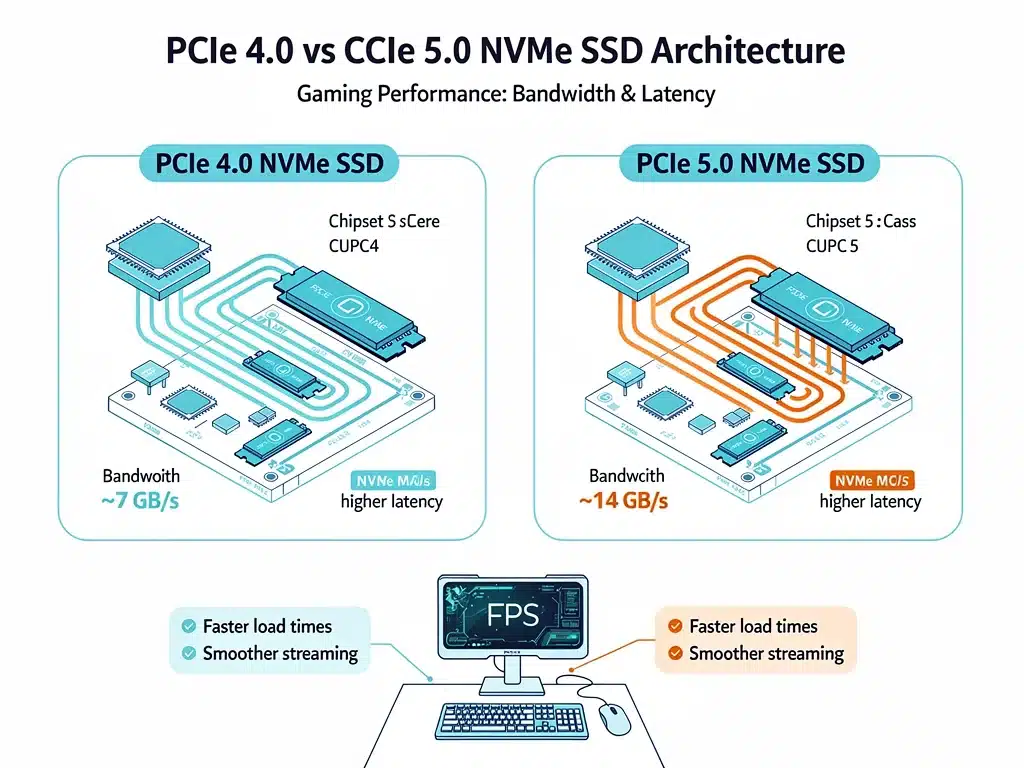
NVMe (Non-Volatile Memory Express) is a communication protocol designed specifically for SSDs, allowing them to communicate directly with the CPU over the PCIe interface. This direct communication dramatically reduces latency compared to older SATA-based SSDs.
PCIe (Peripheral Component Interconnect Express) refers to the physical interface that NVMe SSDs utilize to connect to the motherboard.
Each generation of PCIe doubles the bandwidth of the previous one, meaning PCIe 5.0 offers twice the throughput of PCIe 4.0, which itself doubled PCIe 3.0.
The synergy between NVMe and PCIe 5.0 is what unlocks the staggering speeds we are now seeing in benchmarks. This combination is particularly relevant for applications that demand high sequential read/write speeds and low latency, such as loading large open-world game environments.
Performance Benchmarks: PCIe 5.0 vs. PCIe 4.0
Early benchmarks of PCIe 5.0 NVMe SSDs demonstrate sequential read speeds exceeding 10,000 MB/s, with some models pushing towards 14,000 MB/s. This is a substantial improvement over PCIe 4.0 drives, which typically max out around 7,000 MB/s.
These numbers are compelling on paper, showcasing the raw power of the new interface. However, it is important to note that peak sequential speeds do not always directly translate to proportional improvements in every gaming scenario, as games often rely more on random read/write operations.
Independent testing by tech outlets consistently highlights these performance gains, yet also points out the need for compatible motherboards and CPUs to fully utilize PCIe 5.0. This creates a higher barrier to entry for many gamers, who may need to upgrade their entire platform.
Impact on Game Loading Times
For optimal game loading times, the shift from SATA to NVMe was revolutionary, reducing load screens from minutes to seconds. The jump from PCIe 3.0 to PCIe 4.0 brought further, albeit smaller, improvements.
With PCIe 5.0 NVMe SSDs, the expectation is for even faster loading, particularly in games designed to leverage DirectStorage or similar technologies.
These APIs allow game assets to be streamed directly from the SSD to the GPU, bypassing the CPU and significantly reducing bottlenecks.
While some games may see noticeable improvements, others might not, depending on their optimization and asset management.
The true impact will become more apparent as game developers increasingly design titles with PCIe 5.0 speeds in mind, making PCIe 5.0 NVMe a key discussion point.
Compatibility and System Requirements
Adopting PCIe 5.0 NVMe SSDs requires a motherboard with PCIe 5.0 slots and a compatible CPU, such as Intel’s 12th generation (or newer) or AMD’s Zen 4 (or newer) processors. This means a full platform upgrade for many existing PC users.
Beyond the motherboard and CPU, adequate cooling for PCIe 5.0 SSDs is also becoming a consideration due to their higher operating temperatures under heavy load. Many manufacturers are bundling heatsinks with their high-performance drives to mitigate thermal throttling.
Gamers planning a new build or a significant upgrade in 2026 should factor in these compatibility requirements. Investing in a PCIe 5.0-ready platform will future-proof their system, ensuring they can take full advantage of upcoming storage innovations and game optimizations.
DirectStorage and Future Game Development
DirectStorage, Microsoft’s API designed to accelerate game loading and asset streaming, is a critical component in leveraging the full potential of high-speed NVMe SSDs. It allows game data to be decompressed directly on the GPU, significantly reducing CPU overhead.
While DirectStorage currently supports PCIe 3.0 and 4.0, its benefits are amplified with faster drives. Game developers are gradually integrating DirectStorage into new titles, and by 2026, its widespread adoption is expected to make PCIe 5.0 NVMe SSDs more impactful.
This technology fundamentally changes how games interact with storage, moving beyond traditional CPU-centric data processing. The faster the SSD, the more efficiently DirectStorage can operate, leading to smoother gameplay and quicker transitions in expansive virtual worlds.
Cost-Benefit Analysis for Gamers
The initial cost of PCIe 5.0 NVMe SSDs is significantly higher than their PCIe 4.0 counterparts, a common trend with new technology. This price premium needs to be weighed against the tangible performance benefits for gaming.
For casual gamers or those on a tighter budget, PCIe 4.0 NVMe SSDs still offer excellent performance at a more accessible price point. The real-world difference in game loading times might not justify the additional expense for everyone, especially if their current system is not PCIe 5.0 compatible.
However, for enthusiasts and competitive gamers seeking every possible edge, or those building a top-tier system from scratch, investing in PCIe 5.0 NVMe SSDs could be a worthwhile long-term decision. The choice ultimately depends on individual priorities, budget, and future-proofing aspirations.
Longevity and Future-Proofing Your Rig
Investing in PCIe 5.0 NVMe SSDs in 2026 is a move towards future-proofing a gaming PC. As game engines evolve and DirectStorage becomes standard, the demands on storage performance will only increase.
While PCIe 4.0 drives will remain viable for several years, PCIe 5.0 offers a longer runway for optimal performance with upcoming titles. This ensures that gamers won’t need to upgrade their storage as frequently, saving money and effort in the long run.
The decision to adopt PCIe 5.0 NVMe is not just about current gains but about positioning one’s system for the next generation of gaming experiences. Early adoption can provide a sustained advantage.
Market Trends and Availability in 2026
By 2026, the market for PCIe 5.0 NVMe SSDs is projected to mature, with a wider range of manufacturers offering competitive products. Increased competition typically leads to more accessible pricing, making the technology more mainstream.
The availability of motherboards and CPUs supporting PCIe 5.0 will also be more widespread, further driving adoption. This ecosystem expansion is crucial for the technology to move beyond early adopters and into the broader gaming community.
Industry reports suggest that NAND flash technology will continue to advance, allowing for higher capacities and improved endurance in PCIe 5.0 drives. This will address concerns about drive longevity and storage space for ever-growing game libraries.
Key Manufacturers and Innovations
Major players like Samsung, Western Digital, Crucial, and SK Hynix are at the forefront of PCIe 5.0 NVMe SSD development. They are continuously pushing the boundaries of speed and efficiency, introducing new controllers and NAND architectures.
Innovations extend beyond raw speed, focusing on thermal management solutions and improved power efficiency. These advancements are critical for maintaining peak performance without overheating, especially in compact gaming builds.
As the market evolves, we can expect to see more specialized PCIe 5.0 NVMe SSDs tailored for gaming, featuring optimized firmware and software utilities designed to enhance the gaming experience. This specialization will further solidify the role of PCIe 5.0 NVMe SSDs in high-performance gaming.
The Role of Game Optimization
Even with the fastest hardware, game optimization plays a critical role in achieving optimal loading times. Developers must design their games to effectively utilize high-speed storage, implementing technologies like DirectStorage.
Poorly optimized games, regardless of the SSD speed, will still encounter bottlenecks elsewhere in the system, such as CPU processing or GPU rendering. This underscores the collaborative effort required between hardware manufacturers and game developers.
As 2026 unfolds, we anticipate a greater emphasis on storage optimization within game development cycles. This will ensure that the investment in cutting-edge PCIe 5.0 NVMe SSDs translates into tangible benefits for the end-user, truly transforming the gaming experience.
Software Enhancements and Driver Support
Beyond the physical hardware, software enhancements and robust driver support are essential for maximizing the performance of PCIe 5.0 NVMe SSDs. Operating systems, firmware, and specific drivers must be optimized to handle the immense data throughput.
Manufacturers are continuously releasing updated firmware for their SSDs, often improving performance, stability, and compatibility. Keeping these components up-to-date is crucial for gamers to unlock the full potential of their drives.
The synergy between hardware and software is paramount. An optimally configured system, with the latest drivers and firmware, will ensure that PCIe 5.0 NVMe SSDs deliver on their promise of superior game loading times and overall system responsiveness.
Real-World Gaming Experience
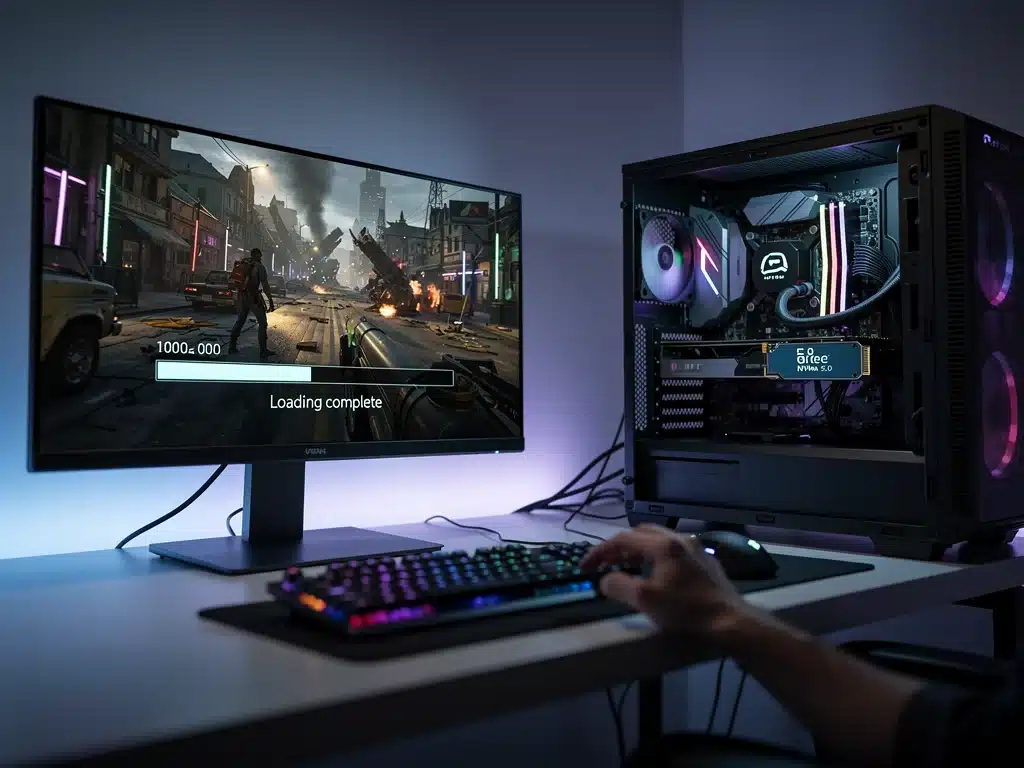
While benchmarks provide objective data, the real-world gaming experience is what truly matters to players. The transition to PCIe 5.0 NVMe SSDs aims to eliminate frustrating load screens and stuttering during asset streaming.
In open-world games with vast environments, the ability to rapidly load textures, models, and audio assets can prevent pop-in and maintain immersion. This seamless experience is a key selling point for the new technology.
Competitive gamers, in particular, stand to benefit from any reduction in loading times, as even a few seconds can make a difference in critical moments. The overall responsiveness of the system, from launching games to switching applications, will also be noticeably improved.
Beyond Loading Times: Overall System Responsiveness
The benefits of PCIe 5.0 NVMe SSDs extend beyond just game loading times. The increased bandwidth and reduced latency contribute to a snappier, more responsive overall system.
Applications launch faster, large files transfer in a fraction of the time, and multitasking becomes smoother. For gamers who also use their PCs for content creation, video editing, or other demanding tasks, these advantages are significant.
Ultimately, the decision regarding PCIe 5.0 NVMe influences the entire computing experience, making a powerful argument for upgrading to the latest standard.
| Key Point | Brief Description |
|---|---|
| PCIe 5.0 Speeds | Doubles PCIe 4.0 bandwidth, offering up to 14,000 MB/s sequential reads. |
| Game Loading Impact | Significant reduction in load times, especially with DirectStorage-optimized games. |
| System Requirements | Requires PCIe 5.0 compatible motherboard and CPU for full utilization. |
| Future-Proofing | Investing in PCIe 5.0 ensures longevity and readiness for future game demands. |
Frequently Asked Questions About Gaming SSDs in 2026
While not strictly essential for all games, PCIe 5.0 NVMe SSDs offer significant advantages for optimal game loading times, especially for titles leveraging DirectStorage. For competitive gamers and enthusiasts, they provide a noticeable edge in performance and responsiveness.
You can expect theoretical sequential read speeds up to 14,000 MB/s, doubling PCIe 4.0. In gaming, this means faster load screens and smoother asset streaming, though actual gains depend on game optimization and system configuration, making PCIe 5.0 NVMe SSDs highly impactful.
Yes, to fully utilize PCIe 5.0 NVMe SSDs, you will need a motherboard with PCIe 5.0 slots and a compatible processor, such as Intel’s 12th Gen or AMD’s Zen 4 architectures or newer. This often means a platform upgrade.
DirectStorage allows games to stream assets directly from the SSD to the GPU, bypassing the CPU, which reduces bottlenecks and accelerates loading. PCIe 5.0’s higher bandwidth greatly amplifies these benefits, making the process even more efficient.
For gamers seeking the absolute best performance, competitive advantages, and long-term future-proofing, the higher cost can be justified. However, for casual gamers, PCIe 4.0 still offers excellent value and performance, making the choice about individual needs for PCIe 5.0 NVMe SSDs.
Looking Ahead
The trajectory for PCIe 5.0 NVMe is clear: faster, more efficient storage is becoming integral to the gaming experience.
As game developers increasingly leverage technologies like DirectStorage and hardware matures, the benefits of PCIe 5.0 NVMe SSDs will become undeniable.
Gamers are encouraged to monitor market developments, consider their upgrade paths, and prioritize how these advancements align with their gaming priorities.